EU Tourism Marketing Faces Major Shakeup as Stricter Anti-Greenwashing Rules Approach
Article Editorial Team

For many years, tourism businesses have relied on broad, feel-good terminology to position their products as sustainable. Terms like "green," "eco-friendly," and "responsible" have become ubiquitous across brochures, websites, and digital booking platforms. However, even when businesses operate with good intentions, broad environmental claims presented without verifiable proof make it increasingly difficult for modern travelers to distinguish genuine operational changes from superficial marketing plottings commonly known as greenwashing.
That regulatory landscape is now undergoing a profound transformation. Beginning September 27, 2026, a sweeping new European Union directive will introduce dramatically stricter rules for sustainability marketing across the bloc. Formally adopted as the Empowering Consumers for the Green Transition (EmpCo) Directive, the legislation sets rigorous legal standards for how commercial enterprises communicate their environmental impact to the public.
For the global tourism industry, adapting to these new measures extends far beyond mere regulatory compliance. It reflects a wider, structural shift toward demonstrating concrete environmental impact rather than simply claiming it in promotional copy. Industry observers note that for operators already undertaking measurable sustainability work, complying with the EmpCo Directive is entirely manageable, provided they overhaul their messaging strategies to match their operational reality.
What is the EmpCo Directive and Why Was It Introduced?
The EmpCo Directive is a targeted amendment to existing EU consumer protection laws. Its primary objective is to shield everyday consumers from misleading environmental assertions while dramatically improving the quality, clarity, and reliability of information they rely on when making purchasing decisions. The legislation directly addresses widespread marketing practices that have plagued consumer markets for years.
Over the past decade, consumer demand for genuinely sustainable products and services has risen sharply. In response, businesses across nearly every sector have increasingly promoted the environmental benefits of their offerings.
However, this rapid, largely unregulated growth in sustainability marketing has simultaneously fueled consumer confusion, leaving travelers struggling to determine which claims can be trusted and what various industry buzzwords actually mean. A comprehensive 2020 European Commission study revealed that an alarming 53% of environmental claims evaluated were vague, misleading, or entirely unfounded. Today, over half of global consumers express outright skepticism or distrust toward brand sustainability claims.

To help restore eroding consumer trust and bring transparency to the marketplace, the European Union adopted the EmpCo Directive. It marks one of the most significant legislative updates to environmental marketing rules in recent years, carrying profound implications for tour operators, hoteliers, travel advisors, and destination marketing organizations worldwide.
Industry stakeholders should note that while they may have also heard references to the proposed Green Claims Directive, the two legislative measures remain distinct. The EmpCo Directive has already been formally adopted and establishes robust rules for business-to-consumer sustainability marketing. Meanwhile, the separate Green Claims Directive aims to introduce even more stringent requirements for substantiating specific green claims, but it has not yet completed the formal adoption process.
Who Do the New Rules Apply To?
When determining the scope of the EmpCo Directive, a simple rule of thumb applies across the international travel sector: if a business sells travel products or services to consumers located within the European Union, or provides products and services to corporate partners who do, these stringent standards must inform all public communications.
The Directive explicitly covers environmental claims made directly to consumers within the EU. For the tourism sector, this sweeps in tour operators, hotels, travel advisors, destination marketing organizations, and any other commercial entity that markets its environmental stewardship to travelers. Even if an enterprise primarily shares communications with other travel businesses rather than retail travelers directly, these requirements remain vital, as corporate messaging is frequently reused downstream in partner consumer-facing marketing campaigns.
Crucially, the physical headquarters or geographical location of a company is irrelevant under the statute. Whether a travel business is based in the United States, Africa, Asia, or Latin America, if it markets travel services to consumers residing in the EU, the rules apply in full force.
What Does the Directive Require of Tourism Businesses?
Under the newly enforced framework, all green claims must be impeccably clear, factually accurate, and heavily supported by credible evidence.

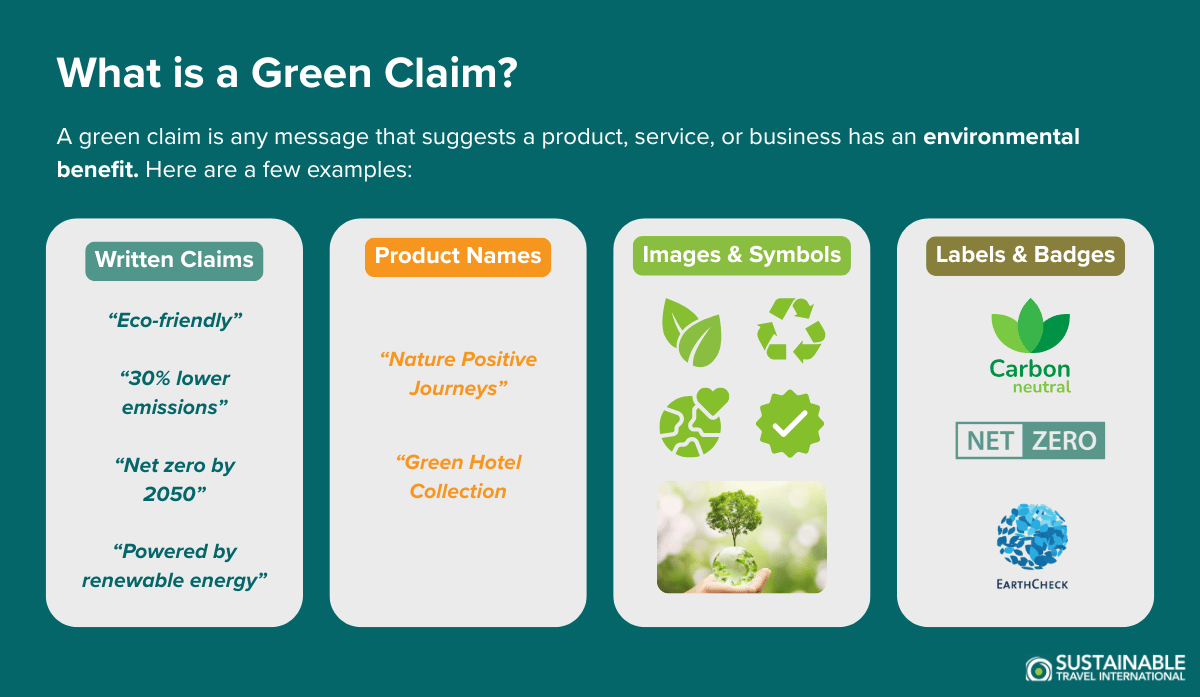
The legal definition of an "environmental claim" under the Directive is broad and extends well beyond written marketing copy. Company names, product titles, corporate logos, visual symbols, and promotional images can all constitute a regulated claim if they reasonably suggest an environmental benefit to the consumer. For instance, a curated tour collection titled "Nature Positive Journeys," an unverified assertion that a hotel is "carbon neutral," or a promotional badge featuring a leaf icon alongside the words "travel consciously" can all be legally interpreted as environmental claims.
While the Directive does not institute a blanket prohibition on every green claim, it strictly regulates how they can be presented to the public.
Replacing Vague Claims with Concrete Specifics
When every hotel claims to be "eco-friendly" and every tour package is labeled "green," those descriptive terms inevitably lose their meaning. Under the Directive, generic environmental claims that lack sufficient specificity to be understood or independently verified are prohibited because they fundamentally mislead consumers regarding a product’s true environmental performance.
Instead of relying on empty adjectives, businesses must describe the specific actions or operational improvements behind the claim. Stating that a company "replaced 90% of domestic flights on our itineraries with train travel, reducing transportation-related emissions by about one-third" succeeds because it transparently outlines the exact action taken alongside its measurable benefit. By contrast, a vague banner reading "climate-friendly tours" communicates nothing substantive to a prospective traveler.
Operators are encouraged to utilize storytelling rooted in concrete examples. Rather than declaring that a lodge is sustainable, marketers can introduce the local farmers providing fresh ingredients for the on-site restaurant or detail how a community habitat restoration project is actively encouraging native wildlife to return. Specific actions become exponentially more compelling when paired with verifiable metrics, such as absolute emissions reduced, waste diverted, water conserved, or the exact percentage of local suppliers integrated into the supply chain.
A very narrow exception exists for broad, generic claims. Terms like "eco-friendly" may only be deployed if they are directly underpinned by a recognized, highly rigorous certification scheme covering that specific claim, such as the EU Ecolabel for Tourist Accommodation or EN ISO 14024 Type I ecolabels like the Nordic Swan Ecolabel and the Austrian Ecolabel.
Managing the Scope of Claims and Legal Requirements
A primary driver of traveler frustration with greenwashing is the tendency to overstate the scope of a business’s environmental practices. The remedy requires clear, accurate communication regarding the exact boundaries of those efforts.
If renewable energy powers solely the corporate administrative office, communication must reflect precisely that, rather than marketing the entire enterprise as entirely powered by renewable energy. Similarly, if only a select few itineraries have been redesigned to lower emissions, operators cannot label their entire global catalog as low-carbon.
Furthermore, businesses must avoid advertising environmental benefits that are already legally mandated by regional or national law. Framing mandatory practices—such as the elimination of single-use plastic bottles that are already legally banned across a destination—as unique corporate sustainability achievements violates transparency principles. Businesses may still mention these practices, but they must present them strictly as compliance with local regulations rather than distinct sustainability leadership.
Separating Operational Reductions from External Climate Funding
The Directive draws a sharp operational distinction between directly reducing a business’s internal environmental footprint and funding external climate action outside of its direct value chain. This distinction carries major weight for tourism companies that purchase carbon offsets or invest in external environmental initiatives.
While both practices serve important roles in global environmental stewardship, they perform entirely different functions. External contributions support broader planetary climate action, but they do not physically eliminate or reduce the direct carbon footprint of a specific hotel stay, flight, or travel itinerary. Consequently, marketing language must strictly avoid suggesting that external climate funding alters or neutralizes the baseline environmental impact of a travel product.
As a result, companies can no longer describe a tour package, hotel stay, or flight as "carbon neutral" or "climate compensated" purely on the basis of purchased carbon offsets. Businesses are directed to communicate offsets accurately: as investments in global climate action that go beyond the emissions reductions achieved internally. Explaining how capital supports external projects like ecosystem protection or renewable energy infrastructure provides transparent context without misrepresenting the carbon reality of a trip.
Mandating Rigorous Evidence and Legitimate Certification Labels
The overarching theme of the legislation is clear: asserting a sustainability credential without robust substantiation is no longer legally permissible. Whether documenting historical reductions in carbon, waste, water usage, or biodiversity protection, businesses must maintain verifiable data tracking progress over time. Future-oriented commitments—such as pledges to achieve net-zero emissions or eliminate plastics by a future date—must similarly be supported by detailed, publicly available implementation plans featuring measurable milestones and independent expert reviews.
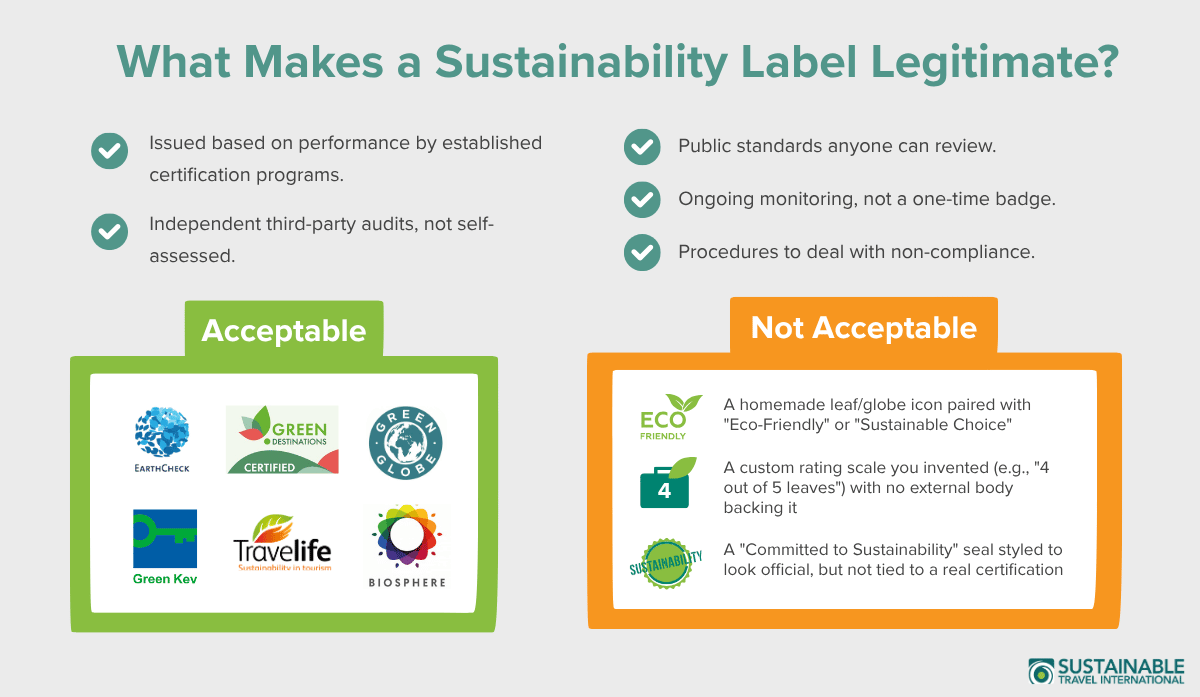
Similarly, sustainability labels and certifications must originate from legitimate sources. Badges, trust marks, or seals indicating that a business meets specific environmental standards must stem from public authorities or established certification programs featuring published standards and independent monitoring, such as Travelife, Green Key, Green Globe, EarthCheck, and Green Destinations. Creating internal, homemade badges like a website "Committed to Sustainability" seal is strictly prohibited unless backed by an accredited third-party body.
By establishing these transparent parameters, the EmpCo Directive aims to reshape travel marketing, ensuring that travelers can make truly informed decisions based on verified facts rather than marketing illusions.
Related News