The Dual Squeeze: How Rising Development Costs and Eroding Revenue Capture Threaten Hotel Asset Value
Article Editorial Team
For hotel owners and asset managers navigating the complexities of modern real estate development, design and procurement discussions have long been dominated by a familiar set of anxieties. Conversations across boardrooms consistently center on soaring steel prices, stubbornly extended supply chain lead times, and the shifting geography of manufacturing origins. While these factors represent an undeniable and challenging operating reality for the industry, industry analysts point out that they describe only one side of a critical financial ratio.
The other side of the equation—measuring what hotel owners actually retain from the money guests pay at the front desk—is moving in the opposite direction. As capital expenditure requirements reach historic highs, hoteliers are facing a simultaneous compression in revenue retention, creating a dual financial squeeze that threatens to undermine long-term asset values across the U.S. hospitality sector.
The Rising Cost of Capital Deployment
The headwinds facing capital projects are deeply rooted in macroeconomic pressures and trade policies. According to Turner Construction’s Building Cost Index, construction expenses reached 1552 in the second quarter of 2026. This figure marks an increase of roughly 34 percent since 2019, a pace of inflation that significantly outstrips general consumer price indices and places an extraordinary burden on ground-up developments and major renovations alike.
At the same time, regulatory and trade measures have added further friction to the procurement process. Section 232 tariffs on imported steel, aluminum, and metal furniture carry penalty rates reaching up to 50 percent. Real estate services firm Cushman & Wakefield estimates that these tariffs add approximately 6 percent directly to material expenses and about 3 percent to total project costs when measured against a 2024 baseline.
Labor constraints compound these material price escalations. Data from JLL reveals that 61 percent of U.S. metropolitan markets are currently grappling with severe construction labor shortages. Industry projections indicate that this figure will worsen, climbing to 72 percent by 2027 and driving labor costs even higher.
This inflationary environment collides directly with a median development cost of $219,000 per room, as tracked by HVS, alongside an immense wave of pandemic-deferred property improvement plans (PIPs). Hospitality portfolios are now forced to reckon with capital projects that were delayed for years, only to find that executing this deferred work in today’s market bids at prices drastically higher than originally scoped. Consequently, this escalating cost curve dominates the daily attention of hotel owners, overshadowing other foundational shifts in asset performance.

The Revenue Capture Squeeze
While construction inflation commands headlines, a second critical curve demands equal scrutiny from asset managers and financial strategists. Kalibri Labs, which tracks hotel commercial performance, monitors what it terms "revenue capture"—defined explicitly as the share of guest-paid revenue that a hotel actually retains after accounting for all demand acquisition costs, including distribution fees, OTA commissions, and digital marketing spend.
In 2025, revenue capture dropped to 79.22 percent across the industry, representing a decline of 111 basis points from the prior year. While a single-percentage-point drop may appear modest on paper, that single-year shift translates to approximately $2.3 billion in lost revenue retention across the entire U.S. hotel market, ultimately driving a staggering $29.2 billion reduction in cumulative asset value.
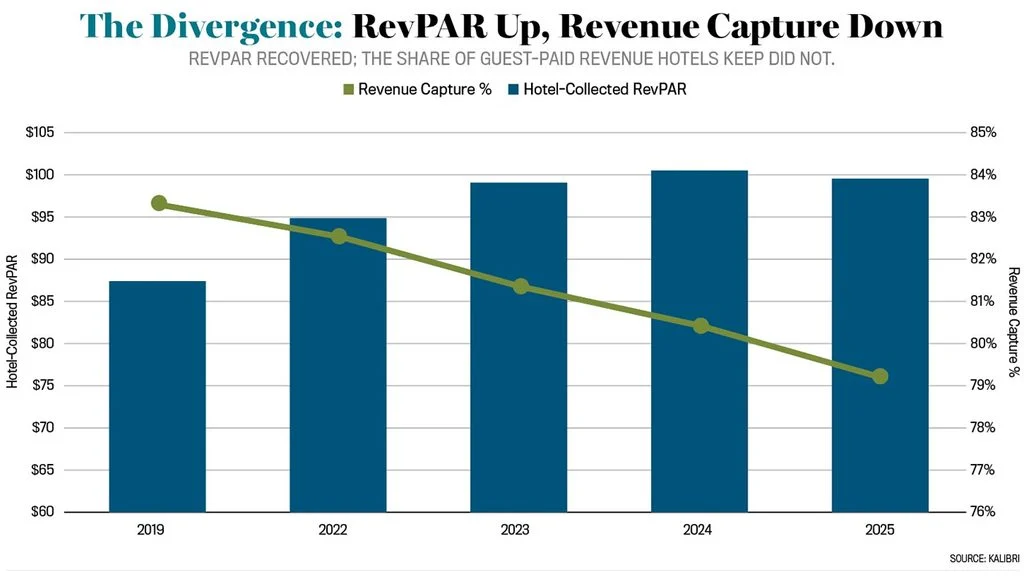
Examining the broader six-year trend reveals how structural changes in digital acquisition have altered hotel profitability. Industry data shows that hotel-collected Revenue Per Available Room (RevPAR) grew from $87.50 in 2019 to $99.47 in 2025. However, across that exact same span, revenue capture steadily eroded from 83.32 percent down to 79.22 percent. While topline revenue metrics appeared to make a full recovery following industry-wide disruptions, the actual share of that revenue retained by ownership quietly dwindled.
Where the Curves Meet
Traditionally, the hospitality industry has underwritten major capital renovations based on projected RevPAR lifts, subsequently grading their success on RevPAR index share gains. In the current market, major developers typically target a 3 to 5 percent gain in index share following a comprehensive renovation as a standard, measurable performance goal.
However, industry experts emphasize that a single point of RevPAR index carries significantly less net profit value today than it did in 2019. Standard financial pro formas continue to assume a stable, historical relationship between the revenue a property produces and the revenue it ultimately keeps, effectively overlooking six consecutive years of cumulative margin erosion.
When a newly renovated hotel reopens and aggressively attempts to rebuild occupancy, it often relies heavily on high-cost acquisition channels to ramp up volume quickly. While this strategy successfully achieves the promised index gain on paper, it delivers severely diluted profit margins to the property owner.

In real estate finance terms, the consequences are stark. Calculated at an 8-cap rate, every $100,000 in additional annual acquisition cost strips roughly $1 million directly from the underlying asset value. A newly opened or recently renovated hotel that leans too heavily on expensive distribution channels or inflated room rates to accelerate its post-renovation ramp can easily cross this threshold, silently cannibalizing the capital that was just invested into the physical asset.
Despite these risks, industry leaders stress that renovations remain an absolute operational necessity. Delaying essential capital deployment only exacerbates the problem, as executing deferred PIPs in a continuously inflating construction market proves far more expensive than addressing them promptly. The necessary evolution, therefore, lies not in avoiding capital projects, but entirely in how the industry measures their success.
A Modern Grading Rubric
To protect their long-term returns in an environment defined by high construction costs and rising distribution expenses, owners are being urged to modernize their underwriting models. Incorporating net revenue per available room—commonly referred to as Net RevPAR—directly into project projections embeds the true acquisition cost of new demand straight into the financial math from day one.
Furthermore, industry strategists suggest that treating the reopening channel mix as a core component of the initial capital planning phase, rather than delegating it as a routine month-one operational hurdle, is essential for preserving the asset’s underlying value. While the hospitality sector has long excelled at forecasting complex renovation costs with surgical precision, applying that exact same analytical rigor to forecasting net revenue capture will be vital in closing the widening gap between what a capital project costs and what it actually delivers to the bottom line.
Related News