New Mural at Big Pine Creek Highlights the Plight and Beauty of the Red-headed Woodpecker
Article Editorial Team
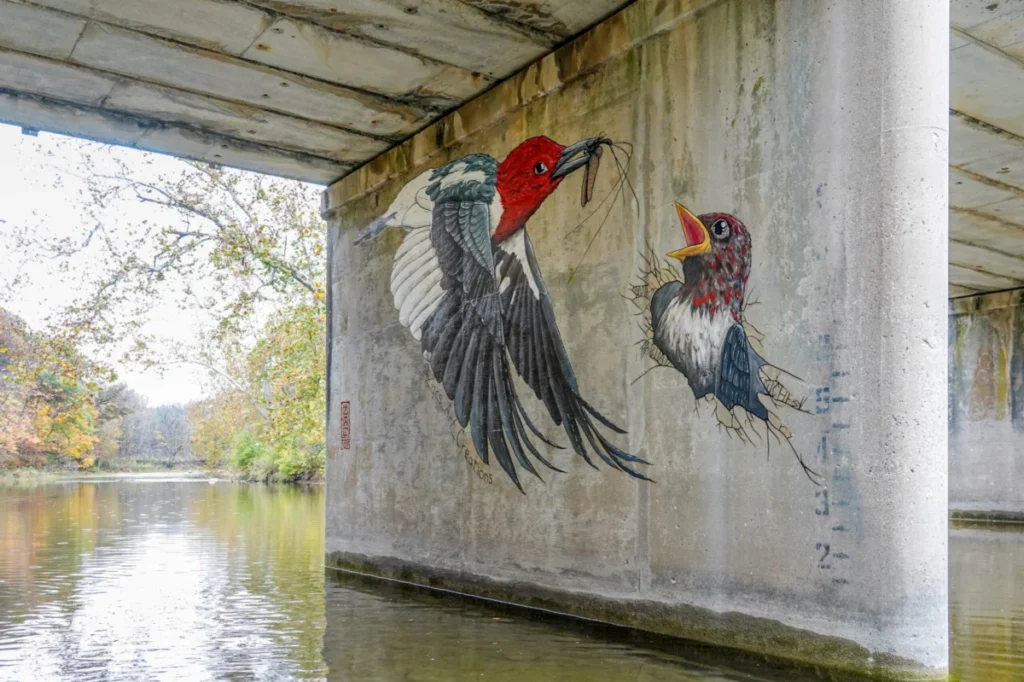
Deep in the heart of Warren County, Indiana, where the landscape is defined by the winding paths of the Wabash River and its tributaries, a new piece of public art has emerged from the concrete. On October 7, 2025, a striking mural was unveiled on the south pylon of the Twin Bridges over Big Pine Creek. The artwork, a high-contrast study in black and white, captures a moment of intense biological intimacy: a Red-headed Woodpecker mid-flight, delivering a mayfly to its nestling.
The mural is a masterpiece of visual storytelling, utilizing the stark, utilitarian surface of the bridge underpass to create an immersive experience. The image depicts the baby woodpecker as if it is breaking through the concrete barrier itself, its eyes wide and luminous as it prepares for its meal. Woven into the splintering, textured design surrounding the bird’s head are three evocative words: "Protect," "Habitat," and "Niches." These words serve as both a thematic anchor for the artwork and a quiet mandate for the viewers who stop to observe the piece.
This installation is the latest addition to a broader initiative under the Audubon Mural Project, which seeks to blend art with conservation advocacy. Commissioned by the Warren County Community Foundation, the project is part of a larger series of public art installations designed to showcase regional wildlife along the river and the Big Pine Creek tributary. For the foundation, the mural is more than just decoration; it is a strategic tool designed to foster a deeper relationship between the public and the local ecosystem.
Michele Stucky, executive director of the Warren County Community Foundation, views the mural as a catalyst for environmental engagement. She believes that the high level of detail in the work will act as a magnet, drawing visitors toward the water’s edge. "Because the mural is so detailed, it will make them want to get closer, whether that be taking off their shoes and wading over or bringing a kayak to get right next to it," Stucky explains. The foundation’s hope is that by providing a visual focal point, they can encourage people to spend more time in the space, transforming a simple underpass into a destination for nature appreciation. By inviting people to pause and look, the foundation aims to cultivate a sense of stewardship among the local community.
The subject of the mural, the Red-headed Woodpecker, was once a common sight throughout the eastern United States. Known for its distinctive, vibrant red head and bold, blocked patches of black and white feathers, the bird is a striking representative of the region’s biodiversity. They are typically found in open habitats, such as clearings and orchards, where they nest in trees and display their agility by swooping through the air to catch insects. Their presence is often announced by a harsh, unmistakable call.
However, the reality for the Red-headed Woodpecker has become increasingly precarious in recent decades. The species has faced significant population declines, driven by a convergence of environmental pressures. Habitat loss remains the primary threat, specifically the removal of the dead trees that these birds require for nesting. Furthermore, they face stiff competition for resources from invasive species like the European starling. As they forage for insects along roadsides, they are also frequently at risk of vehicle collisions.
While the International Union for Conservation of Nature (IUCN) still classifies the species as of "least concern," the long-term outlook is more concerning. According to projections from the Audubon Society’s "Survival by Degrees" report, climate change could result in the loss of 94 percent of the species’ summer range if current global warming trends continue. This makes the mural not just an aesthetic choice, but a timely educational statement.
During the process of painting the mural, the artist, Zac Cody, encountered three of these birds in the immediate vicinity of the bridge. This sighting serves as a hopeful indicator of the area’s ecological health. Stucky notes that the birds’ presence validates the community’s efforts to maintain the landscape. "It’s a nod to good land stewardship," she says. "If you have the Red-headed Woodpecker here, it means you’re doing a good job with how you’re taking care of the land."
The journey of the artist behind this mural, Zac Cody, is as compelling as the work itself. For years, Cody balanced his passion for art—including painting and pottery—with a career in photography. It was a life-altering tragedy in 2023, the loss of his home in a fire, that served as the catalyst for his professional evolution. Emerging from the ashes with little more than his watercolor paints, Cody experienced a profound shift in perspective. The event forced him to reevaluate his trajectory, leading to a decisive commitment to pursue his art full-time.
"I had a big realization," Cody says of the decision. "I wanted to run my own business and try and make it." Since that turning point, he has dedicated himself to capturing the essence of wildlife through various media, moving from intimate watercolor studies to large-scale, site-specific murals.
Cody’s philosophy toward public art is deeply rooted in the environment. He consciously seeks out locations that are integrated into the natural landscape rather than traditional urban settings. He finds that these hidden, remote locations provide a more profound experience for the viewer. "You mostly see murals in urban places," he observes. "But they feel a little more special, hidden, and few and far between out in the country."
For Cody, the process of creating a mural is an exercise in rigorous research and scientific accuracy. Before applying paint to concrete, he meticulously studies the anatomy of his subjects, ensuring that the behaviors and habitats he depicts are biologically sound. This dedication to detail extends to his digital presence, where he shares his work under the handle "Zac’s Art Creations." On social media, he couples his visual art with detailed facts about the wildlife he paints, hoping to bridge the gap between human observers and the natural world.
The mural on the Big Pine Creek is a physical manifestation of this bridge. By bringing the "unseen things" of the forest floor and the canopy into the public eye, Cody hopes to spark curiosity in those who might otherwise overlook the natural world. "What I like to do with my art is highlight unseen things," he notes. "I like to do wildlife up close because it’s a perspective that, if you’re not a photographer or sitting in the woods watching animals, you don’t always see."
As the mural stands under the Twin Bridges, exposed to the elements and the changing seasons of Indiana, it serves as a quiet witness to the environment it portrays. Whether it is the flash of a Red-headed Woodpecker’s wings as it hunts near the water, or a local resident pausing to look at the painted nestling in the concrete, the installation successfully invites a moment of reflection. In a world where habitat loss and climate change pose significant threats to avian species, this piece of public art acts as both a memorial to what is being lost and a call to protect the "niches" that remain. It stands as a testament to the power of art to turn a forgotten piece of infrastructure into a vibrant center for conservation and community connection.
Related News