EU Green Claims Crackdown Forces Tourism Industry to Abandon Vague Sustainability Marketing
Article Editorial Team

Picture a traveler comparing two safari trips. One calls itself “eco-friendly.” The other promises a solar-powered camp with no generator humming at night and a local guide who can follow a leopard by its tracks. Which one do you believe? Which one do you remember?
“Eco-friendly” has long been a staple of travel marketing, but under strict new green claims laws such as the European Union’s EmpCo Directive, that kind of vague language is no longer just a weak pitch—it represents a serious legal risk. Across the tourism sector, operators are realizing that a single shift toward concrete, verifiable storytelling can make their marketing both more credible and significantly more engaging.
Sustainability Buzzwords Don’t Sell
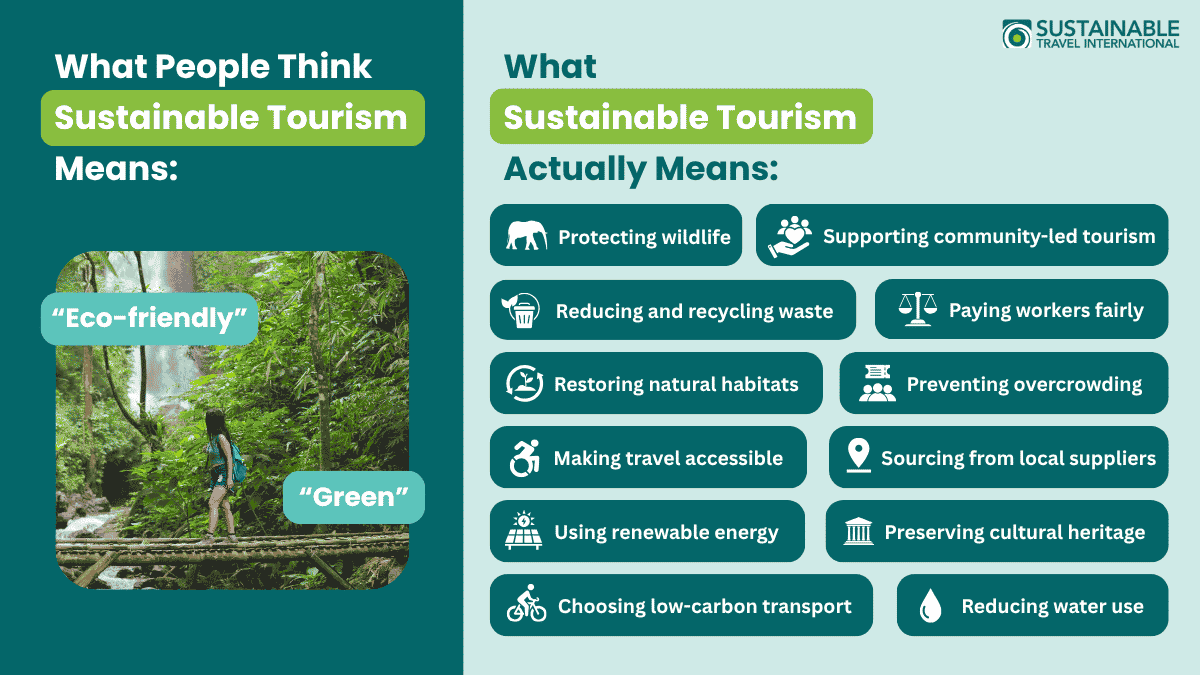
Even in the absence of sweeping green claims legislation, sustainability buzzwords like “eco-friendly,” “green,” and “responsible” have increasingly become a marketing liability. They make it exceedingly difficult for travelers to trust a company or truly care about its operational practices.
The primary issue is a lack of transparency. These broad words fail to tell travelers what a business actually did, where those efforts took place, or how substantial the impact was. Without specific details, consumers are left wondering whether there is genuine action behind the marketing copy or merely a superficial coat of green paint.
Travelers have ample reason to be skeptical. Data from the European Commission reveals that more than half of all examined environmental claims were vague, misleading, or entirely unfounded. It comes as little surprise that many consumers no longer take these marketing promises at face value. While the vast majority of travelers express a personal commitment to sustainability, studies from platforms like Booking.com show that one in four do not trust that trips labeled “sustainable” are genuinely environmentally responsible. Consequently, a vague claim not only fails to drive bookings, but it can also actively breed doubt and erode overall brand trust.
A major contributor to this skepticism is the vastly inconsistent way travel providers use terms like “eco.” A beachfront hotel might market itself as an eco-resort even if local mangroves were cleared to construct the property and untreated wastewater flows directly into the sea. Meanwhile, another hotel down the coast might use the exact same terminology while actively protecting local mangrove forests and recycling its wastewater to irrigate gardens. To a prospective guest browsing a booking site, however, the two properties look identical: palm trees, ocean views, and a small green leaf icon next to the name.
Because most travelers lack the insider knowledge to investigate coastline preservation or wastewater management, repeated scandals involving greenwashing have led many to tune out these claims entirely. This disillusionment ultimately harms the authentic operators who are genuinely living up to their environmental commitments.
Furthermore, catch-all terms like “eco-friendly” and “sustainable” are so broad that they can encompass almost anything—lower emissions, waste reduction, water conservation, wildlife protection, fair wages, cultural integrity, and more. Deploying these labels implies that a business excels across every single metric, an operational near-impossibility. When a company highlights a broad label while only practicing one or two environmental initiatives, discerning travelers quickly begin to pick apart the entire operation. Naming those specific efforts clearly proves far more persuasive.

They Are Easy to Forget
Terms like “eco-friendly” have been repeated so exhaustively across the tourism industry that they have been completely stripped of their meaning, causing travelers to instinctively tune them out. Because competitors lean heavily on the exact same vocabulary in their advertising, these buzzwords no longer serve to set any business apart.
Most importantly, these generic terms bypass storytelling entirely. Rich narratives are what genuinely excite travelers about a trip and demonstrate the tangible value that sustainability adds to an experience. A sterile label like “eco-friendly” simply cannot compete with the imagery of a farmer down the road whose morning harvest brings authentic regional flavors to the evening menu, or the real-world orangutan conservation project supported by an operator to protect the very primate habitats guests travel to witness. Details of this caliber transform sustainability from a bureaucratic label into a compelling reason to book.
What Changed: EmpCo Turned a Weak Story into a Legal Risk
The Empowering Consumers for the Green Transition (EmpCo) Directive is a landmark EU law designed to curb widespread greenwashing by establishing rigorous rules for how businesses communicate their environmental and social impacts. Having taken effect in September 2026, the directive applies to any commercial enterprise marketing travel services to consumers within the European Union, regardless of where the operating company is geographically based.
Tourism providers were already facing growing regulatory and legal scrutiny over their sustainability claims well before the full implementation of EmpCo. In 2024, a Dutch court ruled that advertising claims made by airline KLM were legally misleading because they relied on vague environmental statements to suggest air travel could somehow be sustainable. A year prior, the United Kingdom’s Advertising Standards Authority ruled against Intrepid Travel over its “people & planet-friendly” tagline, determining that consumers would likely interpret the phrasing as broader than the company intended. Similarly, Booking.com felt compelled to withdraw its “Travel Sustainable” badges after a Dutch regulator concluded the label failed to adequately clarify what specific standards it represented.
What the EmpCo Directive fundamentally introduces is absolute clarity. While previous legal cases hinged on whether a specific advertisement could be judged misleading in a given context, EmpCo outright bans broad, unsubstantiated claims such as “eco-friendly” or “sustainable” unless a recognized, independent certification explicitly covers that exact claim. In the absence of such a certification, businesses are legally required to state precisely what actions they are taking and maintain the data to prove it. Furthermore, companies are prohibited from presenting a single isolated green feature—such as providing guests with reusable water bottles—as if it renders the entire travel experience sustainable.
As a result, marketing phrasing that was already proving ineffective now carries immense legal exposure. Operators are increasingly adopting specialized verification tools, such as the Green Claims Checker, to audit their promotional copy and rewrite flagged terminology before regulators or consumer watchdogs intervene.
Stop Making Vague Claims. Start Showing What You Do
The strategic remedy for vague claims remains identical whether a company’s objective is driving better marketing performance or maintaining strict legal compliance: stop treating sustainability as a marketing claim altogether. Instead, operators are encouraged to imagine explaining their practical actions to a traveler who has never even heard the word “sustainability.” Effective marketing should mirror that straightforward explanation, highlighting specific actions taken and explaining why those actions matter in practice.
Robust messaging originates from hard facts: what a business did, the exact location where it happened, and how much it helped. Yet compelling communication also embraces the human and ecological elements that make a narrative real—such as the local resident who welcomes a tour group into her family home for a traditional lunch, or the sea turtles safeguarded by a community partner on an adjacent nesting beach.
For instance, rather than publishing a generic declaration like, “We operate climate-friendly tours,” a company might state, “On our Italy tours, we have replaced 70 percent of domestic flights with train travel, cutting the carbon emissions generated between cities roughly in half.” This allows travelers to easily picture the journey, verify the assertion, and place their trust in the brand, all while remaining fully compliant with regulatory frameworks like EmpCo.
Operators can then bring the experience to life by illustrating what the logistical change means for the traveler’s actual holiday—such as watching the scenic countryside roll past a train window instead of lingering inside airport departure gates, and arriving directly in the vibrant heart of a city rather than an outlying airport terminal. That experiential detail is what makes a journey truly memorable, rather than merely credible.
Measurement Proves Your Story Is True
Numerical data remains one of the most persuasive elements an enterprise can incorporate into its sustainability communications, effectively converting a general promise into concrete, empirical evidence. However, a statement asserting that emissions were cut in half only holds weight if the organization actually possesses accurate measurement data to back it up.
Calculating a trip’s carbon footprint before and after implementing operational changes—such as substituting domestic flights for rail transport—provides exact metrics on the scale of the reduction. This underscores the necessity for travel providers to begin measuring their environmental impacts immediately, establishing a reliable baseline from which to track ongoing progress.
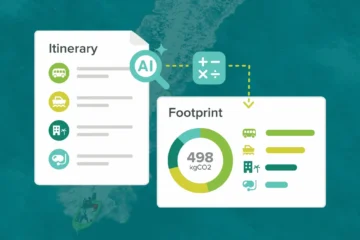
Advanced technological solutions, including AI-powered carbon footprinting tools like Humí, have been developed specifically to streamline this process for the tourism industry. By uploading a PDF tour itinerary or pasting a direct link to a travel package, operators can receive an instantaneous breakdown of estimated emissions spanning accommodations, local transportation, organized activities, and meals down to individual components like regional flights or boat transfers. These figures can subsequently be shared directly with prospective travelers via dedicated carbon labels on tour pages, allowing consumers to evaluate environmental footprints firsthand.
Check Your Wording Before You Publish
Once tourism companies draft their updated sustainability messaging, testing the copy prior to publication has become an essential operational safeguard. By running marketing language through specialized evaluation platforms like the Green Claims Checker, organizations can instantly flag phrases that risk misleading consumers and receive detailed explanations regarding why certain phrasing falls short. Industry bodies, such as Sustainable Travel International, provide members with expanded versions of these diagnostic tools capable of screening against specific regional regulations like EmpCo or California state law, delivering deeper analytical reports and suggested rewrites to catch risky language before travelers, industry partners, or regulatory authorities ever see it.
Ultimately, terms like “eco-friendly” demand blind trust from travelers, whereas specific, measurable details provide a tangible reason to believe—while simultaneously highlighting what makes a particular travel experience unique.
Related News