The Night Shift: How Bats Conquered the Skies 50 Million Years Ago
Article Editorial Team
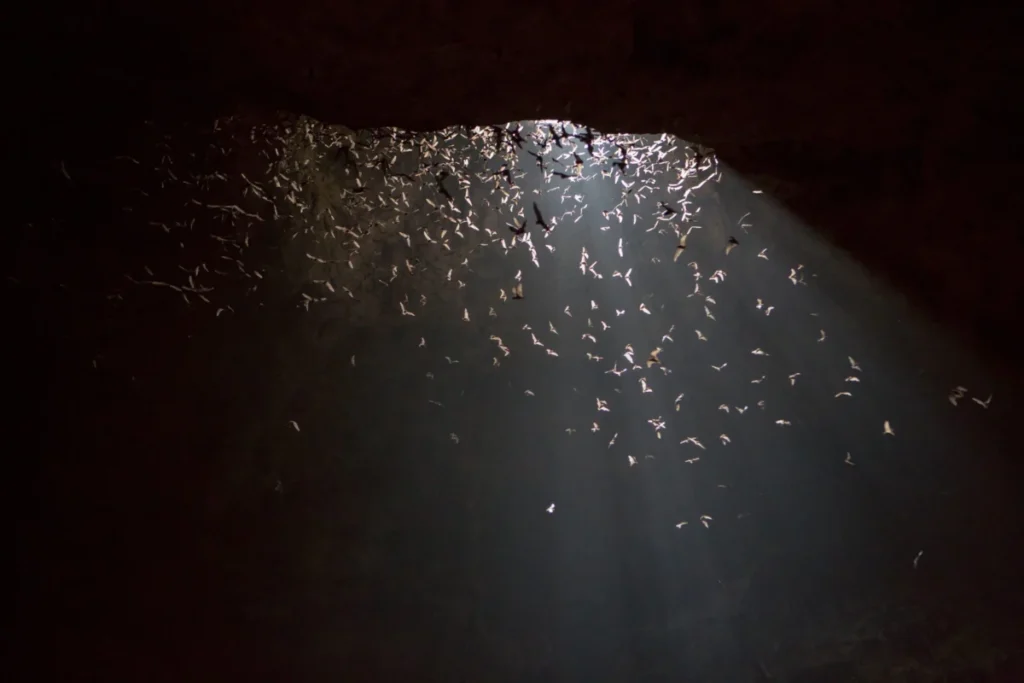
A starlit forest rustles in the velvet gloom of a Cenozoic night. Deep within the shadows, long after the ancient birds have tucked their heads under their wings to sleep, a small, shrew-like mammal clings to a branch, its senses tuned to the subtle vibrations of insect wings. It is an era defined by the silence of the prehistoric world, a landscape only recently reshaped by the cataclysmic asteroid that brought the age of the dinosaurs to a close. In this moment, the creature opens its limbs, revealing a delicate membrane stretched between its fingers and flanks. With a decisive leap, it launches into the darkness, soaring through the canopy. In the grand, expansive timeline of evolution, this singular, daring leap marks a momentous shift. This is the ancestor of the bat, a creature on the cusp of becoming something entirely new, forever changing the composition of the world’s skies.
The transition from a terrestrial life to the mastery of the air did not happen overnight, yet it remains one of the most enigmatic chapters in mammalian history. When the first bats began their ascent between 65 and 52 million years ago, birds had already been diversifying and occupying the skies for nearly 100 million years. The aftermath of the asteroid impact was a crucible of transformation. While non-avian dinosaurs perished, a small subset of avian species—likely ground-dwelling, adaptable survivors—weathered the collapse of the ecosystem. As the world began to recover, these birds expanded to fill the void left by their extinct relatives. Mammals, too, underwent a period of rapid evolutionary experimentation, growing larger and exploring new diets. The skies, however, had remained the exclusive domain of birds and insects. That status quo was about to be challenged by a group of mammals that would eventually claim the night.
Despite the profound impact of their emergence, the fossil record for bats remains tantalizingly incomplete. There are no known transitional fossils that capture the slow, incremental steps from a terrestrial shrew-like ancestor to a fully flight-capable bat. Nancy Simmons, a preeminent bat zoologist and curator at the American Museum of Natural History, notes that scientists must rely on a combination of genetic evidence and evolutionary theory to fill the gaps. "Bats evolved from what we presume to be small, scrambling, insect-eating nocturnal mammals," Simmons explains. She posits that these early creatures likely developed a skin membrane that allowed them to glide between trees—a strategy employed today by flying squirrels and colugos. This transition would have offered a significant survival advantage, providing a safer and more efficient method of movement compared to the energy-intensive process of climbing up and down trunks or navigating the forest floor. Eventually, the skeletal structure of these animals shifted; their finger bones underwent a dramatic elongation to provide the necessary framework to support the membrane, allowing for the transition from gliding to true, powered flight.
The mystery of this transition is underscored by the current state of paleontology. Recent genetic analyses have suggested that the lineage of bats split from other mammalian groups roughly 65 million years ago. Yet, the earliest known bat fossils, which already possess the sophisticated anatomy of modern bats, date back to approximately 52 million years ago. This creates a significant "missing link" in the record. Karen Sears, an evolutionary biologist at UCLA, characterizes the disconnect with stark clarity: "In the fossil record, it’s a shrew-like thing. And it goes: shrew, shrew, shrew… BAT." Regardless of the specific mechanism, the result was a revolution in the aerial ecosystem. With the arrival of bats, birds were no longer the sole vertebrate inhabitants of the skies. To coexist with a well-established and highly diverse avian population, bats carved out their own specialized niche by embracing the night shift.
How Bats Took Over the Night
The success of the bat is inextricably linked to its nocturnal lifestyle. All 1,500 known species of bats are nocturnal, a trait inherited from their shrew-like ancestors who were already well-adapted to the challenges of living in the dark. Many researchers hypothesize that these early bats may have even utilized a rudimentary form of echolocation—the ability to "see" with sound—long before they mastered sustained flight. This adaptation would have allowed them to pinpoint and track fast-moving insects in pitch-black conditions, providing an immediate advantage in a world where visual predators were hindered by the lack of light.
While some birds were certainly active at night during the Cenozoic, the vast majority of avian species were, and remain, diurnal. Today, less than three percent of modern bird species are nocturnal. While specialized creatures like the cave-dwelling Oilbird or certain swiftlet species have evolved to navigate in low-light environments using sound, birds as a group have historically favored the daytime for foraging, hunting, and navigation. This preference left the night sky wide open for the early bats, offering a wealth of untapped resources and ecological opportunities.
"It was a free-for-all," says Sears. The nocturnal environment allowed bats to hunt insects and eventually explore fruit and nectar sources without facing intense competition from diurnal birds. Furthermore, the night provided a cloak of protection, keeping bats safe from the sharp eyes of daytime raptors. There was also a physiological incentive: flying is a metabolically demanding activity that generates significant body heat. By being active at night, when ambient temperatures are lower, bats could better manage their body temperature and avoid the risks of overheating. "There just weren’t a lot of advantages to becoming a daytime animal," Simmons observes.
This strategic expansion allowed for an evolutionary explosion. While birds continued to evolve at a relatively steady pace, bats moved from being a niche group to a global phenomenon. They spread from their ancestral homes in Europe to inhabit every continent on Earth, with the notable exception of Antarctica. Their evolutionary success is reflected in their sheer variety; they have developed an array of social structures, from solitary hunters to massive, complex colonies, and have adapted to diverse diets ranging from insects and fruit to nectar and, in very rare cases, blood. Today, bats represent a full fifth of all mammalian species. They are also remarkably resilient, with eight of the nine longest-living mammal species being bats. They defy the standard biological rules that dictate smaller animals must have shorter lifespans, aging at an incredibly slow rate.
Convergent Evolution: Bats and Birds
Though bats and birds share the skies, they are biologically distinct and entirely unrelated. Their shared ability to fly is a classic example of convergent evolution, a process where different species independently evolve similar traits to solve the same environmental problems. While both groups utilize flight to escape predators, capture prey, and navigate vast landscapes, their methods of achieving lift are wildly different.
Bird wings are formed by fused bones that create a fixed, rigid surface. In contrast, bats have retained the five-digit structure of most land mammals, essentially turning their wings into large, webbed hands. If a human were a bat, our fingers would be as long as our own bodies. This unique anatomical configuration grants bats extraordinary maneuverability, allowing them to independently manipulate their finger bones during flight—a level of agility that surpasses that of most birds. Additionally, the mechanics of takeoff are distinct. Unlike birds, which can launch themselves from the ground, bats are generally unable to stand upright. Instead, they lock their claws onto a surface, hang upside down, and initiate flight by falling into the air.
Despite their different origins, bats are as ecologically vital as their avian counterparts. They are often overlooked simply because they operate in the shadows, yet they are essential to the health of global ecosystems. "There may be just as many bats as birds in your neighborhood, but you just never see them," Simmons notes. They act as critical pollinators and seed dispersers, with some plant species, such as agave, relying exclusively on bats for their survival. Beyond pollination, they are masters of pest control; a single bat can consume thousands of insects in a single night, providing a service that saves the American agricultural industry at least $3.7 billion annually in potential crop damage and chemical pesticide costs. Conversely, they also serve as a foundational food source for various raptors, including owls, hawks, and falcons.
Today, bats face many of the same threats that confront bird populations. Habitat destruction, the broad impacts of climate change, and the spread of devastating diseases—such as white-nose syndrome, which has decimated North American populations—have placed at least 200 species at risk of extinction. Conservation efforts that benefit birds often have a positive ripple effect for bats. Simple actions, such as minimizing light pollution at night, reducing the use of pesticides, planting native vegetation, and protecting known roosting sites, can significantly aid in their preservation.
"It’s a scary world out there," Sears says. Whether during the primordial nights of the Cenozoic or the modern landscapes of the 21st century, the survival of the bat has always been a testament to resilience and adaptation. Like the birds they share the sky with, bats have evolved in tandem with a changing planet. Their evolutionary narrative is far from over, continuing to unfold from those ancient, dark skies to the modern nights of the present day.
Related News