United Airlines Boeing 737 MAX 9 Lands Safely in Houston After Double Emergency Involving Landing Gear and Low Fuel
Article Editorial Team
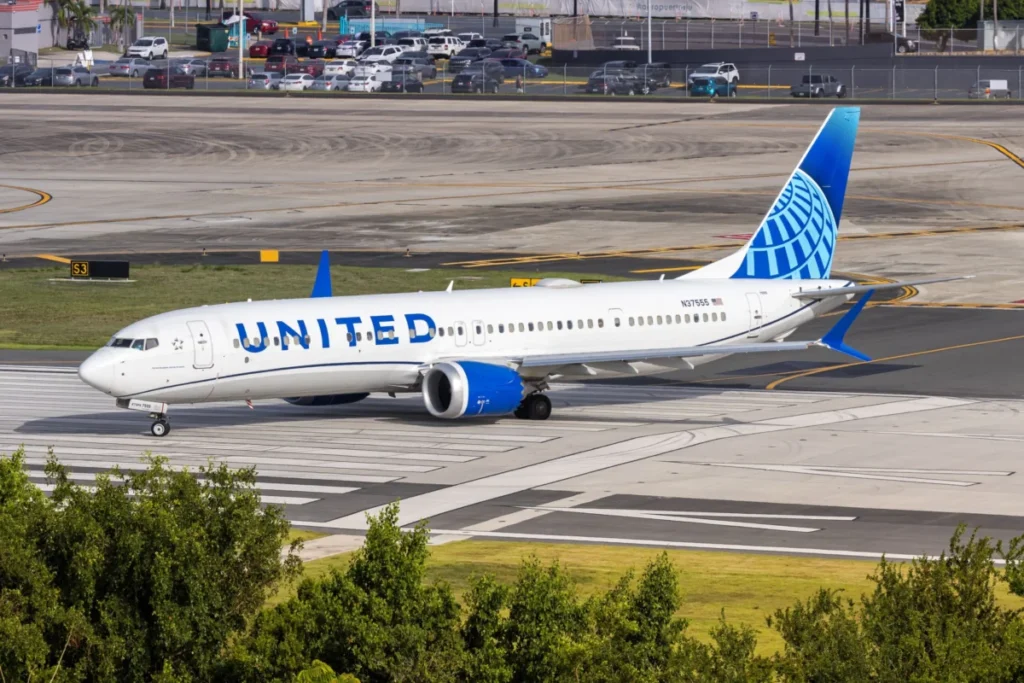
A routine international flight operated by United Airlines turned critical over the weekend as a brand-new Boeing 737 MAX 9 experienced a harrowing double emergency, battling both a stuck landing gear and a rapidly depleting fuel supply during its approach into Texas.
United Airlines Flight 1854, a scheduled service connecting the Cayman Islands to Houston, faced tense moments in the skies on Sunday, October 25, 2026. What began as a standard three-hour journey across the Gulf of Mexico evolved into a high-stakes operational crisis when the aircraft encountered severe mechanical indications upon reaching its destination airspace, forcing the flight crew and air traffic controllers into a race against time to prevent a catastrophe.
United Airlines Flight Has Landing Gear Issues and Runs Short on Fuel
Flight 1854 is operated as a regular twice-weekly route linking Owen Roberts International Airport (GCM)—the principal aviation gateway for the British Overseas Territory of Grand Cayman—with George Bush Intercontinental Airport (IAH) in Houston, Texas. On the day of the incident, the aircraft pushed back and departed from Grand Cayman at 4:28 PM local time, running a modest 17 minutes ahead of its scheduled departure time of 4:45 PM.

For the vast majority of the journey, flight tracking data indicates the nonstop flight proceeded uneventfully. Passengers on board experienced standard cruising conditions at altitude as the twin-engine jet crossed the Caribbean Sea and entered U.S. airspace. However, disaster struck precisely when the flight transitioned into its descent phase toward Houston. As the flight deck crew initiated standard arrival procedures and commanded the landing gear to extend, the system failed to operate correctly.
The pilots quickly realized that the right main landing gear had failed to deploy, remaining locked in the up position. Faced with a critical mechanical indication, the flight crew immediately notified air traffic control at Houston George Bush Intercontinental Airport, formally declaring an emergency. The severity of the situation was independently verified when a passing aircraft in the vicinity visually confirmed that the right main landing gear was indeed still stowed and had not extended properly.
When contacted for comment regarding the incident, United Airlines confirmed that there were 83 passengers on board the aircraft, accompanied by a crew of six, bringing the total number of individuals on the flight to 89. In an official statement provided to the media, the carrier noted: "United flight 1854 from Grand Cayman to Houston declared an emergency upon landing due to a mechanical indication. The plane landed safely, taxied normally and passengers deplaned at the gate."

’90 Souls Onboard’
Radio communications captured between the flight deck and air traffic control paint a vivid picture of the escalating tension inside the cockpit as the situation unfolded. In audio recordings shared by aviation monitoring channels, the captain of the flight can be heard declaring the emergency, noting that there were "90 souls onboard"—a figure inclusive of passengers and crew—and clearly communicating that the right main gear refused to come down.
Air traffic controllers immediately mobilized to assist the stricken aircraft, instructing the flight to execute a low pass over the airfield at Houston Intercontinental. This low-altitude fly-by allowed both ground controllers and observers to visually verify the extent of the landing gear malfunction. However, executing holding patterns and low passes consumes precious fuel reserves. As the aircraft remained airborne while the crew troubleshot the mechanical failure, a new and compounding peril emerged: the jet was rapidly running out of fuel.
The flight crew emphasized to air traffic control that their fuel reserves were dwindling at an alarming rate, estimating that they had a mere 10 to 12 minutes of usable fuel remaining before facing a catastrophic fuel exhaustion scenario. Operating under this extreme time pressure, the pilots maintained close coordination with controllers, requesting that a full complement of emergency response vehicles, including fire trucks and rescue teams, be positioned along the runway prior to touchdown.

As the aircraft circled in a final holding pattern while the crew executed emergency troubleshooting procedures, the stubborn mechanical system finally gave way. The right main landing gear successfully locked into place, resolving the physical barrier to landing just as the aircraft’s fuel margins reached critical lows.
Flight tracking data indicates that the Boeing 737 MAX 9 touched down safely at 8:24 PM local time. Despite the dramatic nature of the approach, there were no reports of any injuries among the passengers or crew members. True to the emergency protocol, the aircraft was immediately met on the runway by first responders, who conducted safety checks before escorting the jet as it taxied normally to the terminal gate, where passengers were able to deplane without further incident.
Aircraft Details: N27474
The aircraft involved in the incident is registered as N27474, a Boeing 737 MAX 9 that stands as one of the newest additions to the United Airlines mainline fleet. Having rolled off the production line just months prior, the twinjet had been in active commercial service for less than three months at the time of the emergency.

The airframe completed its inaugural test flight on August 5, 2026, before being formally delivered to United Airlines on August 26, 2026. It features the carrier’s standard domestic and short-haul cabin configuration, designed to accommodate a total of 179 passengers across a three-class layout. This includes 20 seats in United Business, 48 seats in United Economy Plus, and 111 standard economy seats.
Operational records show that the airframe carries serial number (MSN) 67665 and line number 9792, powered by a pair of modern CFM International LEAP-1B engines. Assigned fleet number 7474 and bearing the hex code A2B8C2, the aircraft was essentially brand new, making the sudden mechanical failure of the landing gear system a notable event for aviation safety analysts examining component reliability in newly delivered commercial airframes.
The successful resolution of the flight highlights the rigorous training and disciplined execution of the flight crew. Faced with a compound emergency involving a partial landing gear failure and an critically low fuel state, the pilots adhered strictly to established emergency checklists. They maintained precise control of the aircraft at safe altitudes, utilized visual verification passes to assess the mechanical state of the landing gear, and successfully managed their diminishing fuel reserves until the system finally deployed, allowing the aircraft to return safely to the ground.
Related News