Rare 1956 Jaguar D-Type with Global Racing Pedigree Heads to Auction for the First Time in Its 70-Year History
Article Editorial Team
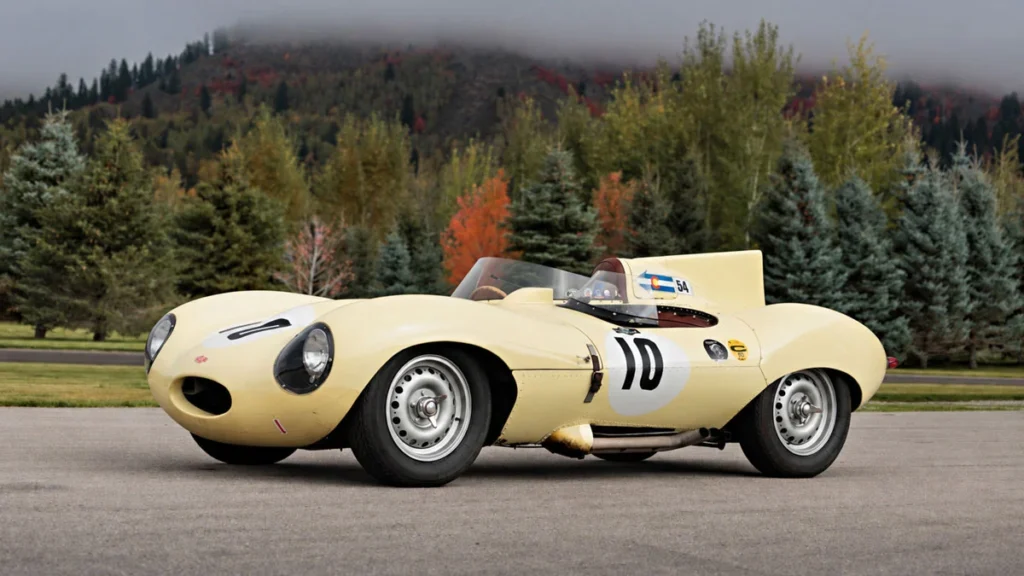
While many of the famed Jaguar D-Type racer’s 71 original examples—built between 1954 and 1957—spend their lives cocooned in climate-controlled enclaves, far away from the very racetracks they were engineered to dominate, not all of them share that sedentary fate. A prime exception is a remarkably patinated, pale-yellow 1956 example bearing chassis No. XKD 552.
Since it was acquired in 2003 by its current owner, a passionate Florida-based weekend racer, the car has been driven aggressively and frequently across the globe. It has seen action at high-profile venues ranging from the Monaco Historic Grand Prix and the Goodwood Revival to the Mille Miglia Storica, the Monterey Historics, the 1,000-mile Colorado Grand, and the dedicated tours for Jaguar C-Types and D-Types organized by renowned Arizona-based Jaguar restorer Terry Larson.

Beyond its active competition life, the car has also been a regular presence at key concours d’elegance events, appearing on green lawns from Amelia Island to The Quail, A Motorsports Gathering. Now, for the first time in its colorful 70-year history, this historic D-Type is being offered for public sale at auction. On November 21, the vehicle will headline the inaugural Gooding Christie’s Retromobile New York sale, presenting collectors with a rare opportunity to acquire a legendary sports-racing machine with an unbroken chain of engagement.
“This D-Type has done it all, and is a great candidate to do it again,” Angus Dykman, a specialist at Gooding Christie’s, tells Robb Report. “Unlike so many cars like this that sit in collections, it has been campaigned successfully at many of the world’s greatest motoring events.”
According to Dykman’s extensive historical research, chassis No. XKD 552 emerged from Jaguar’s legendary Browns Lane assembly line in Coventry in mid-1956. Its birth coincided closely with a golden era for the marque, coming just weeks after Jaguar secured the second of its three consecutive overall victories with the revolutionary D-Type at the 24 Hours of Le Mans. At the time of its completion, however, the car was painted in a somber, utilitarian shade of Battleship Grey and, somewhat surprisingly for such a potent machine, was constructed without a specific customer order waiting in the wings.

During the mid-1950s, Jaguar found itself facing unexpected commercial challenges in selling its advanced, open-topped, aluminum-bodied competition car to privateers. Consequently, chassis No. XKD 552 spent its earliest days being shuffled between various British Jaguar dealerships in a desperate corporate bid to drum up buyer interest. By November 1956, the unsold racer had made its return journey to Jaguar headquarters, where it was officially cataloged among the company’s remaining inventory of factory stock D-Types.
The car’s fortunes finally shifted on May 6, 1957, when a buyer was secured. The machine was formally shipped abroad to Lowis and Hodgkiss, Jaguar’s authorized distributor in Nairobi, Kenya. From that East African outpost, it was delivered directly to its first private owner, South African racing driver John Manussis. Historical records indicate that Manussis was already well-acquainted with the pinnacle of Jaguar sports car engineering, having previously owned an ex-works Jaguar C-Type which he had successfully campaigned across various European circuits. With the keys to chassis No. XKD 552 now in his possession, Manussis wasted little time in putting the D-Type through its paces, racing it locally at the newly inaugurated Nakuru Park racetrack situated in Kenya’s dramatic Rift Valley.
Just a year later, Manussis parted ways with the machine, selling the D-Type to fellow South African competitor Nolis Samaras. Eager to make his mark on the local racing scene, Samaras immediately had the car repainted in a vibrant shade of bright red, complemented by a broad white racing stripe running down its length. Samaras continued to campaign the vehicle regularly at Nakuru Park, adding to its growing international lore.

The car’s global journey took another unexpected turn in 1963, when a new buyer emerged from North America. Montreal-based Roger Lucas, a prominent local jewelry designer with a penchant for high-performance European machinery, purchased the Jaguar and had it repainted in an eye-catching gold finish. Archival photographs, which are included as part of the official auction lot documentation, capture Lucas proudly parading the striking Jaguar through the bustling streets of Montreal. Other notable images show the D-Type parked prominently outside his retail store, frequently flanked by personal bodyguards—a testament to both the car’s captivating presence and its owner’s flamboyant lifestyle.
By 1965, chassis No. XKD 552 had changed hands once again, passing into the ownership of acclaimed Canadian photojournalist Don Newlands. The car remained in Canada for a period before eventually making a transatlantic voyage in 1989 to Switzerland, where it found a secure home as part of the esteemed Eric Traber collection. It was during Traber’s ownership that the decision was made to commission renowned D-Type specialist Terry Larson to execute a comprehensive, ground-up restoration at his specialized workshop in Arizona.
During this extensive restoration process, Larson followed specific instructions from Traber to strip the car and finish it in its current shade of pale yellow, while also fabricating and installing a trademark D-Type aerodynamic headrest fin behind the driver’s seat. Furthermore, to preserve the mechanical integrity of the original components during competitive use, Larson removed the car’s original 3.4-liter inline-six XK engine, placing it into safe storage, and installed a freshly rebuilt period-correct engine block in its place. Notably, the sale of the vehicle includes its original, matching-numbers engine, offering the next custodian complete historical authenticity.

Following its meticulous restoration, the Jaguar embarked on an energetic modern era of vintage competition, with subsequent owners eagerly returning the machine to legendary racing circuits around the world. This chapter began in earnest in 1991, when Bruce Lustman, a prominent East Coast collector and historic car racer, acquired the automobile. In 1997, the car was purchased by Ned Spieker of Atherton, California, who actively entered the D-Type in high-end endurance driving events such as the Mille Miglia Storica and the Monterey Historics.
When the current Florida-based steward acquired the car in 2003, he seamlessly continued this tradition of active motoring, entering the D-Type in a multitude of premier driving events across the United States and Europe, frequently sharing the cockpit with his son as co-driver. Among its many competitive outings during this era, the car participated in the prestigious Lavant Cup race dedicated exclusively to D-Types during the 2004 Goodwood Revival, demonstrating that its competitive spirit remained entirely undimmed.
As Gooding Christie’s prepares to bring the car to the auction block for its Retromobile New York sale, specialists have placed a pre-sale estimate of between $6 million and $7 million on the historic racer. While substantial, this figure sits considerably lower than the astronomical $21.78 million fetched by the Le Mans-winning 1955 D-Type—chassis No. XKD 501—when it was sold by RM Sotheby’s during their Monterey auction in 2016.

“It’s an approachable estimate for an example of this caliber,” Dykman notes, emphasizing the unique market position of chassis No. XKD 552. “It is rare to find a D-Type that has both a rich, engaging history spanning multiple continents and retains so many original components, exhibiting a high level of overall purity.”
With its documentation complete, its matching-numbers engine safely accounted for, and a documented history of global use that sets it apart from its museum-bound peers, the pale-yellow D-Type stands ready for its next chapter. Whether the winning bidder chooses to continue its legacy on the world’s most demanding historic racing circuits or displays it proudly on the concours lawn, chassis No. XKD 552 remains a testament to the enduring appeal of Jaguar’s greatest racing creation.
Related News