Celebrating Culinary Visionaries: Meet the Trailblazers of Eater’s National Chef of the Year Category
Article Editorial Team
Each of the chefs featured in the new national Chef of the Year category has made headlines in a major way over the past year. However, their most recent restaurant projects represent just one chapter of a much larger, more complex story. This year, the culinary world celebrates five extraordinary chefs who are making a profound impact not only on the specific cities where they cook, but also on the larger, ongoing national culinary conversation.
Selected as part of this year’s Eater Awards, presented by Capital One, these chefs exemplify a deep commitment to personal heritage, innovative technique, and storytelling through food. From the coastal traditions of Peru and the rich culinary tapestry of Iran to the unique agricultural bounty of the Sonoran Desert, these trailblazers are redefining what modern dining looks like across the United States.
Laura Ozyilmaz, Maria Isabel — San Francisco, California
San Francisco diners first became widely acquainted with the powerhouse culinary couple Laura and Sayat Ozyilmaz through their passionate championing of Eastern Mediterranean cuisine at Dalida. That restaurant, which opened in 2023 inside a historic building tucked into the lush environs of the Presidio, told the personal story of Sayat’s upbringing and culinary influences in Istanbul, Turkey. The venture quickly earned critical acclaim for the duo’s refined and inventive cooking.

In the years since Dalida’s successful launch, diners have come to know Laura on an even broader scale, particularly outside of her collaborative work with her husband. She completed an impressive and memorable run on Top Chef in 2024, where television viewers watched her deftly plant one foot in Mediterranean food traditions and another in Mexican cuisine, showcasing her exceptional skill and versatility in both fields throughout the season.
With the 2026 debut of the Ozyilmazes’ restaurant Maria Isabel, the food feels like an even fuller, more personal expression of Laura’s heritage and life history. Named directly after Laura’s sister, Maria, and her mother, Isabel, the restaurant is deeply steeped in Mexican matriarchy. The dining room highlights female winemakers, exquisite ceramics crafted by Mexican producers, and authentic, indigenous Mexican ingredients.
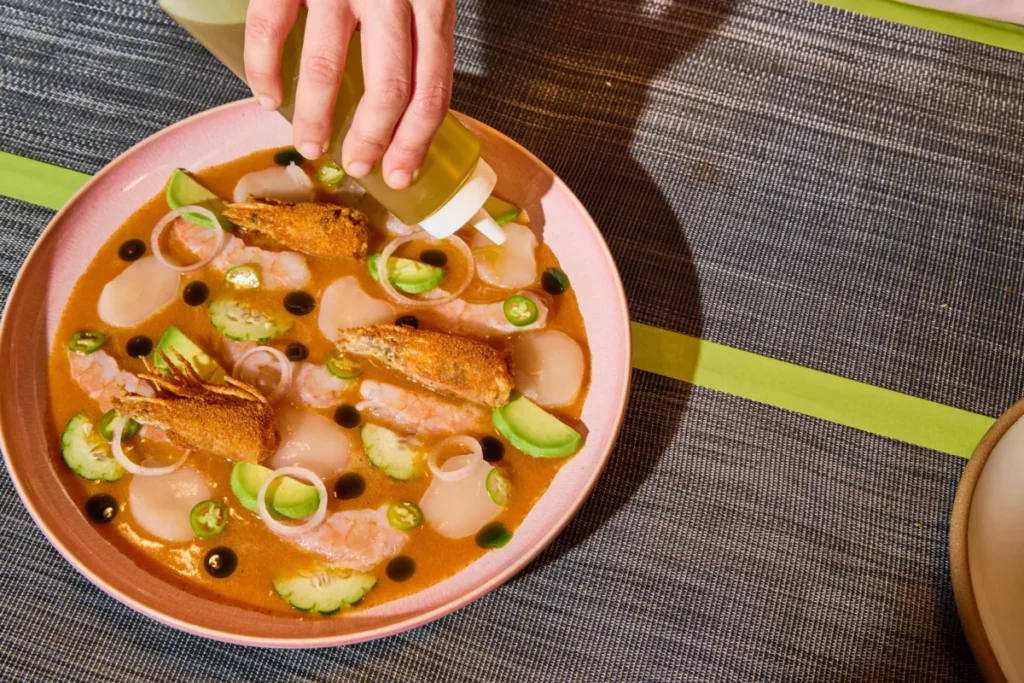
The menu channels Laura’s childhood upbringing in Guerrero alongside her family’s Sinaloan roots, recounted through a thoughtful lens focusing on mariscos, maiz, complex moles, and salsa macha. For instance, the ceviche Acapulqueño brilliantly reimagines the classic street-food version—often laden with Fanta and ketchup—instead utilizing vibrant marigold flowers and preserved Seville oranges to dress tender raw shrimp and scallops, topped with delicate flower petals and three fried shrimp heads.

Elsewhere on the menu, duck enmoladas showcase the profound depth of mole negro contrasted against a rotating seasonal mole, such as a peach manchamanteles or a vibrant rhubarb rendition. Chochoyotes, a lesser-seen dish in the San Francisco dining scene, demonstrate the kitchen’s ability to apply masa in inventive ways—in this case, shaped into comforting dumplings—while harnessing the deeply earthy flavor of huitlacoche. Ultimately, Maria Isabel serves as both a conduit for diners to connect with complex Mexican flavors and a vivid window into Laura’s personal vision of the Mexico of her past and her future.
Carlos Delgado, Maru San — Washington, D.C.
Chef Carlos Delgado’s meteoric rise through the Washington, D.C. culinary scene began in earnest in 2022 with the opening of Causa, a tiny, highly acclaimed tasting room located in the Shaw neighborhood. At Causa, he sends diners on an imaginative seafaring voyage along the Peruvian coastline and up into the Andean mountains where he grew up. Upstairs, the companion pisco destination Bar Amazonia completes the experience. Delgado’s meticulous sourcing and refined culinary skills quickly drew widespread critical acclaim, leading to prominent recognition in Michelin guides and James Beard Award nominations.
For the Lima-born chef, 2026 has shaped up to be his biggest year yet. His breakout project, Maru San, commanded instant buzz across Capitol Hill upon opening in February. The restaurant features an orchestra of Nikkei-style hand rolls, sashimi, and other polished seafood plates that Delgado and fellow José Andrés alum Simon Lam pass across a sleek 25-seat black marble counter. All the while, a large pink octopus mural adorns the wall, and Delgado’s favorite tropical house music plays softly in the background. A rare few diners manage to sample the restaurant’s elaborate tasting menu, which features high-end ingredients like premium sea urchin and dry-aged fish; securing a reservation for the 15-course feast is notoriously difficult.

At just 36 years old, the ambitious chef is not afraid to stretch his talents in multiple directions. Last year, he linked up with the Eaternity Group to give the Mediterranean-themed restaurant La Vie a much-needed menu makeover at D.C.’s prominent Wharf development. Meanwhile, plans for at least one additional Maru San location are already in the works elsewhere in the D.C. area.
This drive sounds a lot like his former mentor. Before launching Causa, Delgado honed his craft under the tutelage of José Andrés, serving as the longtime executive chef at Penn Quarter’s celebrated Peruvian mainstay, China Chilcano. To this day, the two chefs still text frequently, maintaining a strong professional bond.
Amir Hajimaleki, Roya — Austin, Texas
While Amir Hajimaleki has operated American-leaning restaurants in Austin for well over a decade, he never previously had the opportunity to fully express himself as an Iranian-born, Texas-raised chef. That changed with the opening of Roya, his most personal restaurant to date and a project that has been in development for more than eight years.

At Roya, Hajimaleki manifests the incredible depth and diversity of Persian cuisine—a bold and ambitious feat in the middle of Texas. The physical space, designed in collaboration with his brother Ali Hajimaleki, feels immediately transportive. It features intricate tile mosaics, rich burnished gold and dark blue hues, and delicate, glowing chandeliers.
Roya truly highlights the extent of Hajimaleki’s culinary capabilities, best experienced through the sofreh dining experience, an $85 prix fixe menu. After servers lay down a delicate white lace tablecloth, they walk guests through Hajimaleki’s modern interpretations of classic Iranian dishes. Highlights include shirin polo, a nutty, crunchy, and sweet jeweled rice; ghormeh sabzi, a tangy short-rib herb stew made remarkably richer with roasted bone marrow; and a trio of exceptionally juicy kebabs. The meal concludes with traditional tea service, dessert, and a thoughtful take-home box of tea and cookies, designed to evoke the warm feeling of receiving parting gifts when leaving a family home. Hajimaleki even calls his grandmother back in Iran to consult on the development of new dishes, cementing Roya as both a heartfelt tribute to his homeland and a chronicle of his personal history.
Phila Lorn, Sao — Philadelphia, Pennsylvania
There has been an undeniable, electric energy pulsing through the Philadelphia restaurant scene in recent years. The city, long viewed as a culinary underdog, has consistently punched above its weight class, and the rest of the country has finally taken notice. Amid this broader cultural buzz, a couple of newer establishments have managed to step out from the shadows of the city’s established culinary icons: the Cambodian noodle house Mawn, which opened in 2023, and the Southeast Asian oyster house and raw bar Sao, which opened last September.

At the helm of both ventures is the slick, stylish Phila Lorn. The restaurants that he operates alongside his wife, Rachel, feel remarkably singular. They seamlessly blend the influences of Lorn’s Philadelphia upbringing with his Cambodian background, resulting in food that feels playfully free and emboldened by a complete lack of rigid boundaries between global cuisines.
At Mawn, playful touches see funnel cake meeting coconut macaroons, while vinegar peppers enhance delicate scallops served in a fragrant red curry. At Sao, the crispy rice in the nam khao salad—which prominently features Italian sausage—feels conceptually analogous to Italian arancini. Meanwhile, the tuna carpaccio is served with crispy shallots and jalapeños, then cured in fresh lime juice until it absorbs the aromatic essence of the classic bowls of beef pho found nearby on Washington Avenue.
Listening to Lorn talk, complete with his South Philly-bred bravado and routine deployment of local vernacular, it becomes abundantly clear that the city’s culinary community is listening, rallying behind him, and eager to experience everything he brings to the table.

Aaron Lopez, Ursa — Tucson, Arizona
Tucson-based chef Aaron Lopez possessed a unique vision that initially took root in his small California hometown of El Centro, an agricultural community situated near the U.S.–Mexico border. There, he first hatched a comprehensive plan to create a menu deeply imbued with the distinct techniques and flavors of the Sonoran Desert, a vast region spanning northern Mexico, Arizona, and southeastern California.
Having trained in top-tier kitchens in Los Angeles and beyond, Lopez conducted extensive personal research by traveling deep into the desert landscape, armed primarily with a camera, his culinary instincts, and a profound curiosity. A year later, he and his wife, June Chee, brought the project to Tucson—a larger venue still deeply embedded in the desert ecosystem, but one ready for a broader audience.
Inside a high-ceilinged, brick-walled space in downtown Tucson, Ursa operates as a hushed, gallery-like setting for Lopez and his kitchen team to execute a $150 tasting menu. The dishes expertly merge ancient Indigenous cooking techniques with locally foraged and farmed ingredients. The meal often begins with a striking first bite: barrel fruit—a bright yellow cactus—punctuated by the sharp tang of pickled chiltepin leaves, offering a luscious treat rarely found on traditional fine dining plates.

Subsequent courses include quail breast served on a metal skewer, dressed in pickled yucca and hovering gracefully over a comforting jujube broth like a quiet offering. Later, goat roasted in agave using a pit barbacoa technique is unveiled tableside and served over softened tepary beans.
At every turn, avoiding extraneous or decorative adornments, Lopez’s kitchen allows the native produce and meats to proudly display their innate nature. By eschewing conventional culinary comforts and reimagining a meal composed primarily of cactus, corn, sunflower tea, and native beans as true luxuries, Lopez delivers results that are both evocative and powerful. His overarching message—highlighting the inherent value, beauty, and resilience of the desert landscape, its people, and its indigenous ingredients—forms the very core of his culinary philosophy, echoing like the sweet, sustaining pith of the cactus found just beneath the surface of the American Southwest.
Related News