The 2026 Eater Awards Honorees: The Standout Restaurants and Trends That Captured the Culinary World
Article Editorial Team
The past year in dining has been marked by what industry insiders are calling the "Great Chickenings," an influx of fine dining establishments flipping into more affordable concepts, unexpected British food invasions, and dining rooms thoughtfully designed to feel like cozy living rooms. At the same time, vibrant global steakhouses and unserious Y2K food trends have captured the public imagination.
As part of the annual rollout of the 2026 Eater Awards, presented by Capital One, a slate of winners has emerged to celebrate undeniable new chef talent, core-memory-forming dishes, and groundbreaking bakeries and bars. Yet, during months of expansive scouting and research, the editorial team encountered a distinct crop of restaurants and bars that, while missing the ultimate cut for the main awards, commanded enough attention to demand a special acknowledgment. These are the specific places, dishes, and design choices that the culinary team simply could not stop thinking about.
Cabbage of the Year: Monte’s in Montecito, California
Cabbage is having an undeniable moment in the cultural zeitgeist. From a star turn on the Sandy Liang runway as a ruffled bag to hand-painted Bordallo Pinheiro dinner sets and a formal declaration from Vogue that the leafy green has officially gone “chic,” the cruciferous vegetable has claimed the title of 2026’s “it” girl.

This cult of the cabbage has naturally found its way to Monte’s in Montecito, a cozy Korean American bistro where cone cabbage is coal-roasted and kissed with a salty, smoked shiitake XO sauce—an umami-heavy, contemporary spin on the Hong Kong-born classic. The fall-apart-tender cabbage rests on a bed of creamy tofu puree, with the entire dish studded with hazelnuts that deftly bring out the vegetable’s innate sweetness. Preparations like this suggest that cabbage is much more than a fleeting seasonal trend, cementing its culinary dominance for the foreseeable future.
Best Bathroom Party: Bobo in Chicago, Illinois
Whether it was the expertly poured Negroni, the classic Old Fashioned, or the gingery, mezcal-laced Missed Opportunity cocktail, something left a lasting impression on visitors at Bobo, the Filipino bar attached to Muhajir in Chicago’s Lincoln Park neighborhood. In an era where the restaurant bathroom selfie has become a cultural fixture, Bobo has answered the call with refractory horizontal-mirrored panel walls and colored lighting that subtly shifts from deep reds to vibrant greens, transforming the lavatory into a mesmerizing disco ball. It is a fitting, high-energy touch that perfectly matches chef Jacob Dela Cruz’s overarching vision for a red-light district-esque tropical hideaway.
Most Unhinged Martini: The Dirty Fish at Kelang in Brooklyn, New York
In a contemporary cocktail landscape saturated with increasingly outrageous martini variations, the rendition at Greenpoint Malaysian restaurant Kelang easily earns its playful moniker. The Dirty Fish reimagines a traditional Vesper by combining gin, vodka, dry vermouth, and, most notably, fish sauce, which elevates the drink’s savoriness across every dimension. The pungent condiment mimics traditional olive brine, delivering a punchy, salty taste of the sea to an already formidable drink, which is then garnished with wavy scallions and a long sliver of aromatic ginger. The cocktail serves as a liquid tribute to owner Chris Low’s background as a Malaysian kid growing up in New York. Served simply as a cloudy libation in a stemmed coupe glass, it pairs best with fluffy paratha served over creamy, spicy dal.

Best Low-Key Power Lunch: Little Fish Melrose Hill in Los Angeles, California
Gone are the days of traditional business power lunches at classic white-tablecloth powerhouses that mandated a rigid suit and tie. In their place, a more relaxed yet discerning configuration has taken root: the low-key power lunch. There may be no better place for a midday meal masquerading as a professional meeting than Little Fish in Melrose Hill, the first full-service restaurant from the celebrated former pop-up-turned-fish-sandwich window.
The light-filled dining room hums during daytime hours with flexibly scheduled creatives and well-dressed parents toting young children, all while patrons sip carefully curated wines selected by sommelier Kae Whalen. On the menu, a tuna melt crafted by maverick chefs and owners Anna Sonenshein and Niki Vahle converts even skeptics, especially when paired with peppery fries dipped in horseradish aioli. While the signature fried fish sandwich remains a calling card, savvy diners often opt for the beach sandwich layered with guindilla peppers and soy-cured mussels, rounded out by a bay leaf chip stracciatella flecked with chocolate chips.
Most Camp: Night Hawk in Coronado, California
California has historically been a gold mine for architectural kitsch and theatrical dining, ranging from Clifton’s Republic to the pillowy pink dining room at the Madonna Inn. Night Hawk serves as the newest jewel in that camp crown. The Greek-influenced San Diego restaurant anchors Coronado Island’s hypermaximalist new Baby Grand hotel, beckoning diners into a lush, faux-rock-filled outdoor dining room complete with pink clamshell chairs, cascading waterfalls, and cocktails bearing whimsical monikers like the Adonis in Bloom and the Spanakopita Punch.

Best British Import: Ambassadors Clubhouse in New York City
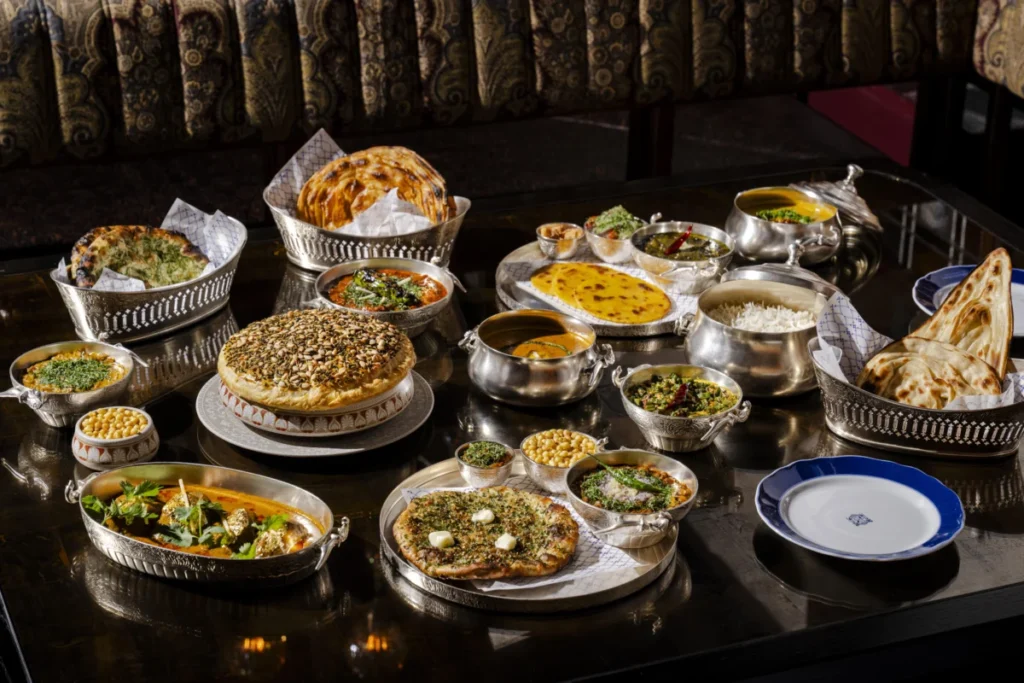
British cuisine hit a national fever pitch over the past year as American diners awakened to the complex allure of regional pub fare and savory pies. However, if any single establishment permanently dispelled outdated notions of British food as dull or monochromatic, it was Ambassadors Clubhouse. The restaurant features an extensive menu of Punjabi showstoppers, including seven-layer, aloo-filled, Amritsari-style samosas; butter chicken presented as lollipop-like chops with a heady char; and matka Beliram lamb, where pools of crimson oil signal immense depth of flavor. Set within opulent, velvet-adorned surroundings that offer a welcome hideaway from the urban bustle, this luxe London import makes a compelling case that Indian food is just as essential to contemporary British culinary identity as fish and chips.
The Marry Me Restaurant: Little Mountain in Montecito, California
Some of the most striking new hospitality spaces in California are tucked discreetly into local shopping centers, such as Little Mountain in Montecito’s upper village. Opened under the direction of chef Diego Moya, the restaurant delivers far more than a locavore menu anchored by live-fire cooking; it introduces an Architectural Digest-worthy destination that commands attention.
Guests navigating reservations must choose between several distinct spaces: a comfortable dining room illuminated by gold-veil natural lighting and furnished with plush caramel booths and banquettes; a larger-party table framing an open kitchen and its centerpiece hearth; a dark, intimate bar that stands as one of the sexiest drinking dens on the Central Coast; a covered patio flowing into a monarchial private dining area; and an outdoor patio evoking a home garden. Across every section, the space offers an immaculate backdrop for a remarkable meal.

Best Endless Euro Summer Restaurant: Heretík in Denver, Colorado
Chef Theo Adley introduced Heretík to the Denver dining scene, successfully injecting a breath of fresh, San Sebastián-esque sea breeze into the local culinary landscape. The French- and Basque-leaning establishment serves an endless-summer menu featuring Santa Barbara uni, a playful pan con tomate martini, and scallops à la plancha served with béarnaise and seaweed. The coastal European ambiance is amplified through interior design elements incorporating vintage furniture and tapered, wax-drip-laden candles, balancing romantic sensibilities with a distinct sense of cheek.
Most Valuable Egg: Dean’s in New York City
The British-inspired seafood pub Dean’s demonstrated that traditional scaling does not always apply when executing classic tavern fare, specifically through its unique take on the Scotch egg. Rather than utilizing standard chicken eggs, the kitchen employs quail eggs. While larger Scotch eggs can sometimes suffer from an uneven meat-to-egg ratio across bites, this shrunken-down approach guarantees a favorable balance. Every bite simultaneously captures crunchy breading, tender meat filling, a runny yolk, and just enough bouncy egg white, making it as nonnegotiable an order as a proper pint of Guinness.
Pop-Up We Need to Go Permanent: Ladyfish in Portland, Maine
From its inception, Ladyfish in Portland, Maine, framed itself as a temporary affair, boldly declaring itself “a summer fling” upon its arrival. Jordan and Marisa Rubin of the local sushi spot Mr. Tuna successfully convinced chef Christine Lau to relocate from New York City to helm the seasonal seafood pop-up. Lau, whose professional background spans Japanese-Italian and Chino Latino concepts, applied her distinctive perspective to classic Maine ingredients. Standout dishes included scallops blanketed in fried milk bread and a showstopping twin lobster mountain served alongside fries, rice cakes, and a dan dan au poivre sauce. True to its premise, the pop-up concluded its run at the end of October, leaving diners hopeful that the return of warm-weather crowds will ultimately resurrect this seafood pairing.

Best 2.0 Comeback: Broken Spanish Comedor in Culver City, California
Chef Ray Garcia opened Broken Spanish Comedor in Culver City, marking a triumphant return years after the closure of his groundbreaking modern Mexican fine dining restaurant, Broken Spanish, and its casual counterpart, B.S. Taqueria, in Downtown Los Angeles. Garcia’s ongoing contributions to Alta California cuisine—rooted in traditional Mexican cooking told through a distinct California lens—remain among the most influential of his generation. Housed in a striking A-frame structure, the Comedor nods to the homestyle restaurant traditions of Mexico while feeling entirely fresh. Locals and hospitality industry insiders regularly frequent the space for crispy, crown-whorled chicharron or quesillo-threaded refried lentils, supported by a classic-leaning beverage program featuring cocktails, cervezas, and wine.
Best Hangover Cure: Casimiro in New Orleans
For a city frequently in need of effective remedies following spirited evenings, New Orleans gained a reliable morning-after destination in Casimiro. Helmed by award-winning Acamaya chef Ana Castro, the all-day cafe delivers precisely what is required after a night out: textbook chilaquiles, impossibly fluffy conchas, crispy pescaditos, and one of the most substantial tortas available in the city. For those opting to continue with the "hair of the dog" approach, a well-balanced Cynar daiquiri provides a fitting conclusion to the meal.
The Pastry Disruptor: Dahlia in Minneapolis
Among the more unconventional pastry innovations of the year was the application of “lettuce cream” lacquered onto the BLT Danish at Dahlia in Minneapolis. The chartreuse-colored cream anchored a slice of late-August tomato alongside dollops of bacon jam atop crisp laminated dough. Tucked discreetly into an office complex, the bakery consistently produces pastries of exceptional caliber, including jam-filled croissants with speculoos crumble, expertly executed English muffins, and plush milk bread and fluffy focaccia tailored for sandwiches, pushing the boundaries of contemporary baking.
Related News