Airlines Must Expand Beyond Flights as AI Reshapes Travel Planning, Says Agoda CCO at Skift Aviation Forum
Article Editorial Team
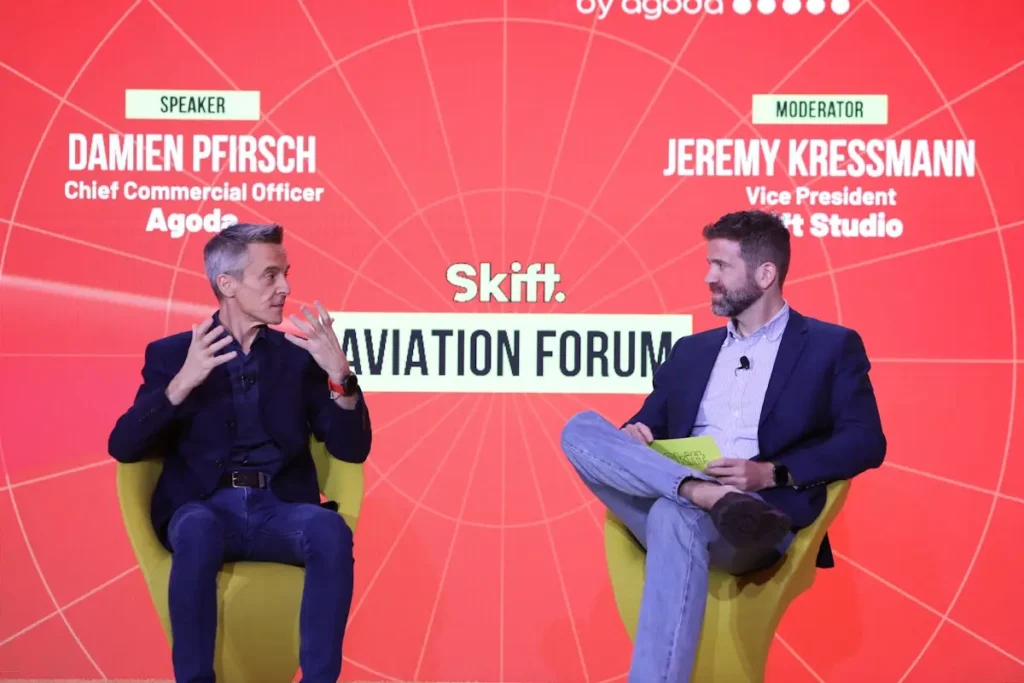
As artificial intelligence rapidly transforms how consumers research, plan, and book their itineraries, airlines are facing a critical juncture in how they interact with their passengers. Speaking at the recent Skift Aviation Forum, Damien Pfirsch, Chief Commercial Officer of Agoda, outlined the pressing strategic choices facing aviation executives as the digital landscape evolves. Moderated by Jeremy Kressmann, Vice President of Skift Studio, and sponsored by Rocket Travel by Agoda, the session zeroed in on a fundamental challenge for the modern airline industry: how to capture a larger share of the overall travel journey without losing the direct, high-value connection with the customer.
The rapid rise of AI agents and automated trip-planning tools means that traditional booking funnels are being rewritten. For decades, airlines have relied primarily on point-to-point ticket sales as the core anchor of their customer relationships. However, as travelers increasingly turn to conversational AI platforms and sophisticated aggregators to assemble entire trips—spanning flights, accommodations, ground transportation, and ancillary experiences—carriers risk being reduced to mere utility providers in a much larger ecosystem.
The Decision Brief
The core message emerging from the Skift Aviation Forum is that airlines have a historic window of opportunity to extend their customer relationships well beyond the boarding pass. Pfirsch emphasized that the traditional boundaries defining an airline’s role in the travel ecosystem are blurring. Today’s travelers expect seamless, end-to-end experiences, and they frequently look to trusted brands to guide them through the complexities of trip planning.

Yet, meeting these evolving expectations requires a delicate balancing act. Airlines must determine how to effectively combine their proprietary, airline-owned interfaces with external AI platforms and specialist industry partners. By leveraging the right combination of technologies and partnerships, carriers can deliver a much larger portion of the overall travel journey. At the same time, they must navigate these integrations carefully to maintain a direct, unmediated connection with their travelers, ensuring they do not forfeit critical customer data and loyalty to third-party tech platforms.
The Takeaway
The central takeaway for airline leadership is that passivity is no longer an option in an AI-driven marketplace. As artificial intelligence tools become more adept at synthesizing complex travel data and preferences, travelers will gravitate toward platforms that offer frictionless, comprehensive solutions. If airlines confine their digital strategies strictly to flight reservations, they leave the most lucrative segments of the travel spend—such as hotels, car rentals, and destination activities—open to nimble digital competitors and tech giants.
To counter this, aviation companies are evaluating how to position themselves as comprehensive travel orchestrators. This strategic pivot involves more than just bolting a hotel search engine onto an airline website. It requires a sophisticated integration of data, user experience design, and strategic partnerships that allow the airline to remain at the center of the consumer’s travel universe. Whether a passenger is booking a routine business trip or a complex multi-destination vacation, the airline should ideally be positioned as the primary concierge guiding the experience.

Paths Forward and What to Watch
As the industry charts its course through this technological transition, aviation executives are closely watching how major carriers implement new distribution models and AI-driven interfaces. The deployment of generative AI tools in customer service and booking paths is accelerating, forcing airlines to upgrade legacy systems that have historically hindered rapid innovation. Furthermore, the collaboration between airlines and specialized travel technology providers—such as Rocket Travel by Agoda—highlights a growing recognition that carriers do not need to build every component of the travel ecosystem from scratch. Instead, partnering with established accommodation and loyalty experts allows airlines to rapidly deploy robust ancillary offerings while retaining their brand equity.
Industry stakeholders attending the Skift Aviation Forum and reviewing the insights from the event’s attendee hub are focusing heavily on how these digital strategies will materialize over the coming years. The ongoing evolution of distribution standards, the shifting dynamics of airline loyalty programs, and the adoption rates of consumer-facing AI agents will dictate which carriers successfully capture the modern traveler’s loyalty. As the boundary between flying and the broader travel experience continues to dissolve, the airlines that thrive will be those that embrace collaboration, harness advanced technology, and keep the traveler’s comprehensive journey at the heart of their commercial strategy.
Related News