Beyond the Salt Flats: Finding a Deeper Perspective on Bolivia’s Gringo Trail
Article Editorial Team
While the classic South American travel route through Bolivia is well-worn and familiar, seasoned travelers and travel writers are increasingly pointing out that the nation’s most iconic highlights—La Paz, Sucre, and the blinding expanse of the Salar de Uyuni—represent only a fraction of what the country has to offer. For visitors looking to move beyond the predictable itineraries of the standard "gringo trail," the goal is rarely to find an entirely undiscovered village in the middle of nowhere. Instead, it is about choosing destinations that offer a different rhythm, shifting the focus from high-speed sightseeing to red-rock valleys, ancient archaeological ruins, and opportunities to slow the pace of travel.
For those whose itineraries are beginning to feel too rigid or heavily traveled, a handful of underrated destinations provide an alternative window into the country’s geography, history, and daily life.
Samaipata Is Where I’d Go for a Breather
Samaipata feels fundamentally distinct from the dramatic, rugged mountain towns situated further to the west. Benefiting from a milder climate and a noticeably slower pace, it is the kind of destination where lingering for a few extra days makes far more sense than rushing through for a single overnight stop. The primary historical draw is El Fuerte de Samaipata, a significant archaeological site featuring an enormous carved rock and rich pre-Columbian history. However, travelers often find that the town itself serves as an ideal base for unwinding. Surrounded by accessible countryside and free from the frantic pressure of catching a connecting bus every few hours, it offers a much-needed mental and physical reset.
The dramatic shift in altitude is another factor that makes Samaipata such a valuable addition to an extended journey. Sitting at approximately 1,650 meters above sea level, the town offers a substantial drop in elevation compared to the bracing heights of La Paz. After spending days coping with the demands of thin mountain air, that atmospheric change provides a remarkably welcome form of relief.

Tupiza Is the One for a Completely Different Landscape
When most people picture Bolivia, their minds instantly turn to the glaring white salt flats of Uyuni. Yet, arriving in Tupiza introduces an entirely contrasting environment defined by arid valleys, striking red rock formations, and sweeping canyons. This southern detour feels a world away from the salt plains, offering a rugged, cinematic landscape that completely redefines the traveler’s visual impression of the country.
While visitors can explore the region on foot, horseback riding has emerged as a premier way to take in the vastness of the valleys. Experiencing the terrain from horseback introduces a sense of immersion and tranquility that cannot be replicated by spending another afternoon on a crowded bus or ticking boxes on a standard sightseeing tour.
For those already passing through Tupiza, El Sillar stands out as a geological formation well worth noting. These dramatic, wind-sculpted earth pillars provide yet another compelling reason to linger in the area rather than treating Tupiza as a mere transit stop between larger regional hubs.
Tiwanaku Is for Travellers Who Want More Than Pretty Views
Venturing off the beaten path does not always require traveling vast distances into remote regions. Tiwanaku sits relatively close to the primary tourist trail, yet it frequently gets sidelined as travelers rush onward to Lake Titicaca and other blockbuster attractions. Despite its proximity to major routes, it remains easy to bypass, even though it offers a profound contrast to standard scenic stops.

The archaeological complex grants visitors a rare look at a sophisticated civilization that predates the Incas by centuries. While the site is dense with historical significance, it is a destination where a small amount of preliminary research yields immense rewards. Without proper context, visitors risk wandering aimlessly among colossal stone blocks, struggling to understand the historical weight of what they are observing.
At the same time, practical realities must be kept in mind, particularly regarding elevation. Tiwanaku sits at an altitude of roughly 3,850 meters, meaning travelers have by no means escaped the high-altitude conditions of the Altiplano simply by departing La Paz. Approaching the site with a measured pace—especially if visited early in a trip—allows for a deeper appreciation of the ruins without inducing altitude-related exhaustion. Furthermore, because it sits neatly along regional travel paths, it can be integrated alongside a visit to Lake Titicaca without requiring a complete overhaul of an itinerary.
Oruro Has a Very Different Side When Carnival Is Over
It is nearly impossible to mention Oruro without immediately evoking the legendary Carnaval de Oruro. As one of South America’s most massive cultural festivals, it unites vibrant costumes, traditional dance, complex music, and deep religious devotion, transforming the entire city into a dynamic spectacle during the event. Yet, the city possesses a character that extends far beyond its famous annual celebration.
Its rich mining heritage and distinct local culture become much more accessible to visitors once the festival crowds have dispersed. Experiencing Oruro outside of the carnival season grants travelers the chance to engage with a working city defined by its everyday traditions rather than a single massive event. For those prioritizing cultural depth over party atmosphere, timing a visit outside the festival window is essential, while also checking local calendars to ensure smooth transitions regarding accommodation and transport.

Huayna Potosí Is Off the Tourist Route in a Different Way
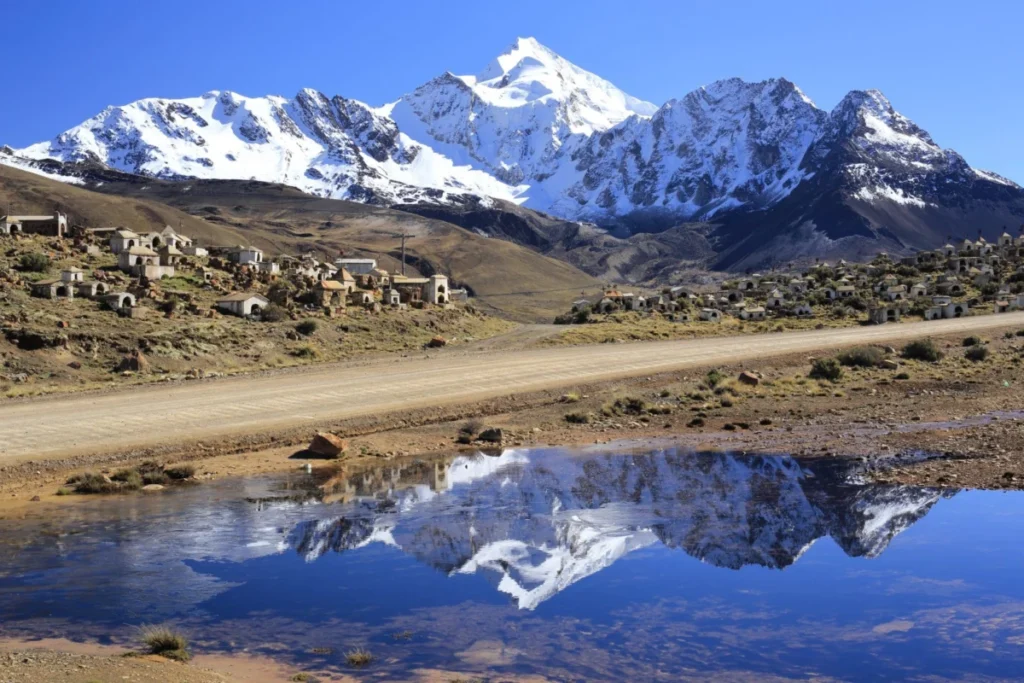
Huayna Potosí is by no means an undiscovered secret. Located close to La Paz, it is widely recognized by the international adventure community, but that familiarity does not diminish the uniqueness of the experience. Rather than viewing the Andes from a comfortable roadside viewpoint, climbers here attempt to ascend them.
Soaring past 6,000 meters, the mountain demands a multi-day commitment alongside experienced guides. The final push to the summit requires navigating technical snow and glacier conditions, making it an endeavor that cannot be casually squeezed into a tight travel schedule. For adventurous spirits, however, it provides an uncompromising way to experience Bolivia from its highest peaks rather than looking up from below.
Because of the extreme altitude, freezing temperatures, and physical demands of summit day, rushing is out of the question. Proper acclimatization is mandatory, and selecting a reputable operator equipped with reliable gear and seasoned mountain guides is critical for safety.
Sometimes the Detour Is the Point
Ultimately, the value of straying from the standard route lies in perspective rather than obscurity. A destination does not need to be entirely unknown to offer a transformative experience; rather, it is about taking familiar regions and engaging with them differently. Whether that means riding horses through the red canyons of Tupiza, enjoying a slower afternoon in the mild climate of Samaipata, or granting Tiwanaku the historical attention it commands, the rewards come from intentional detours. Even a challenging alpine climb like Huayna Potosí, while widely known, fundamentally shifts how a traveler perceives the geography surrounding La Paz.

For a two-week itinerary in Bolivia, attempting to squeeze in every remote destination is a recipe for exhaustion, as long transit times frequently disrupt plans. Instead, these locations naturally align with broader regional tracks: Samaipata pairs seamlessly with Santa Cruz, Tupiza anchors the south, Tiwanaku is easily reached from La Paz, and Oruro anchors cross-Altiplano journeys. Leaving a buffer for unexpected delays ensures that a minor bus schedule change does not derail the entire trip.
Ultimately, these alternatives do not require visitors to ignore Bolivia’s famous marquee sights. La Paz and the Salar de Uyuni remain profoundly worthwhile, but integrating a few deliberate, less obvious stops transforms a standard vacation into a much richer, more nuanced exploration of the country.
Related News