The Modern Marketing Production Crisis: How AI and Professional Stock Media Are Redefining Creative Workflows
Article Editorial Team
Modern marketing faces an unprecedented production problem. Today’s brands are expected to generate exponentially more content, deploy it across a rapidly multiplying number of channels, and maintain a faster pace than ever before in the history of commercial communication. A single marketing campaign frequently requires dozens of distinct visual assets before it successfully reaches all of its intended audience segments across the globe.
Yet, despite this massive shift in scale and demand, many creative workflows still begin in the exact same place: zero.
Every new campaign traditionally starts with sourcing, creation, layout, adaptation, and multiple grueling rounds of production. That approach made logical sense in an era when each marketing push generated a relatively small, manageable number of assets. It has become fundamentally inefficient in an environment where a single core concept must support websites, social media platforms, paid media campaigns, corporate presentations, video channels, and localized international markets simultaneously.
Artificial intelligence offers a promising way to accelerate this process, but its greatest productivity benefit may not come from generating everything completely anew. Instead, the true breakthrough lies in helping creative teams make far more effective use of professional content that already exists.
Most Creative Production Is Not Actually About New Ideas
When audiences interact with finished advertisements, striking website banners, or engaging social media posts, they rarely see the immense operational weight required to produce them.
Once a creative direction has been chosen by a brand, designers still face the heavy burden of preparing multiple sizes, layouts, and placements. They may need to manually adjust crops, reconstruct complex backgrounds, carve out more negative space for copywriting, adapt compositions for mobile-first viewing, and ensure that a singular concept maintains its integrity across several entirely different channels.
This distinction matters profoundly because creative teams spend a significant percentage of their time on tasks that are operationally necessary but not particularly creative. The central concept may already be finalized, approved, and celebrated. What remains is purely execution.
Artificial intelligence has the immense potential to reduce this production burden significantly. When repetitive adaptation becomes faster and more automated, designers can spend more time on decisions that actually affect how a campaign looks, feels, and performs in the real world.
Stock Media Was an Early Solution to the Same Problem
The underlying concept of leveraging pre-existing material to save time and resources is not entirely new. Stock media originally became popular because it allowed brands to completely avoid recreating visual material that already existed elsewhere. A company needing a professional photograph of a modern workplace, a bustling city, a family, a natural landscape, or an industrial environment no longer needed to commission a completely bespoke, expensive photo shoot every single time a new brief crossed the desk.
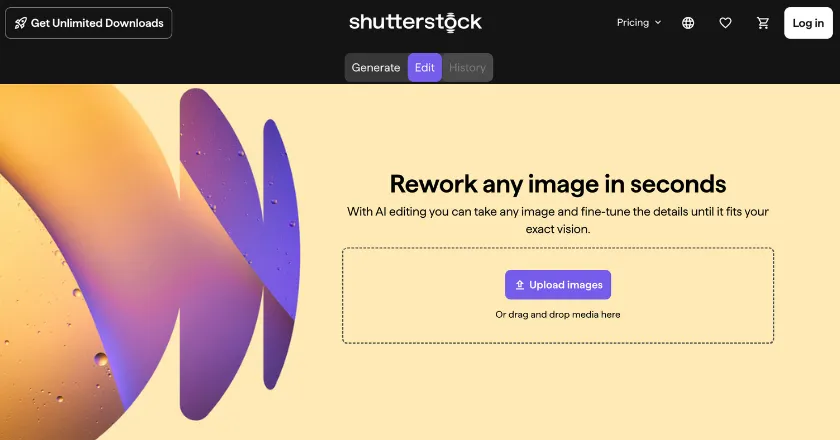
Professional libraries made visual production far more efficient long before artificial intelligence ever entered the creative workflow. Platforms such as Shutterstock expanded this established model by giving teams access to exceptionally extensive collections of professional photography, illustrations, vectors, and video assets. Creative professionals could begin their work with high-quality source material instead of managing every single tedious stage of production themselves.
Historically, the limitation of this approach was that the chosen stock asset often needed to match the final campaign requirement very closely. Significant changes to the original composition usually meant expensive, tedious, or time-consuming manual editing by a skilled designer.
That limitation, however, is now rapidly weakening.
AI Makes Existing Assets More Flexible
The powerful combination of professional stock media and modern AI-assisted editing tools is radically transforming how creative teams evaluate source material.
Suppose a designer finds an image that possesses the exact right atmosphere, subject matter, and visual quality required for a brief, but the original composition simply does not fit the required campaign format. The original image might have been shot horizontally, while the active campaign concurrently requires square, vertical, and ultra-wide versions to meet various digital placements.
Previously, this technical mismatch could easily trigger another exhausting search or demand substantial manual editing work. Today, that same asset remains a remarkably strong choice because the technological distance between the original source and the final output has become dramatically easier to bridge.
This shift alters the fundamental question designers ask from "Is this asset already perfect?" to "Does this asset give us the strongest possible foundation?" By reframing the evaluation process, the practical value of professional visual libraries expands exponentially.
The Source Asset Is Becoming a Modular Component
Stock content used to be treated primarily as a finished product—a static image dropped into a layout with minimal alteration. That is no longer the sole operating model in modern marketing.
A professional image can now function much more like a modular production component. Teams can effortlessly use it across several distinct formats, combine it with other visual elements, integrate it seamlessly into motion video, or adapt it for completely different digital channels. The original asset becomes the starting point of the workflow rather than the definitive end.

This shift is particularly critical because modern campaigns rarely stop at a single output. One creative idea must generate an entire family of assets, each carrying different technical constraints and dimensions. By starting with robust professional material and extending it through AI-assisted production, teams can avoid recreating the same visual foundations repeatedly from scratch.
Search Time Is Production Time
Creative efficiency is not only a matter of editing and post-production. Finding the right content within a massive digital archive can itself consume significant operational time.
A broad search query such as "professional team meeting" may instantly return thousands of technically relevant images. Yet, the actual creative brief may demand much more specific attributes: natural lighting, a particular age range, an informal yet professional atmosphere, enough negative space for copy integration, and a composition that feels spontaneous rather than heavily staged.
The difference between relevant and truly usable can be substantial in a fast-paced agency environment. This is why better discovery tools have such a direct and immediate impact on overall team productivity.
AI-supported search, advanced recommendation systems, and sophisticated filtering options help teams reach suitable content much more quickly. Large digital libraries become exceptionally powerful when sheer scale no longer translates into endless, frustrating browsing. For industry services such as Shutterstock, better discovery turns a broad catalogue into a practical creative advantage, ensuring teams not only have access to more content, but can pinpoint the exact right asset faster than ever before.
One Idea Now Has to Survive Multiple Formats
The sheer volume of outputs expected from a single marketing campaign continues to grow unabated. A single core concept may need tailored versions for desktop homepages, mobile vertical feeds, e-commerce product pages, programmatic display ads, electronic billboards, and localized social media platforms.
Each of these distinct placements imposes rigid technical constraints. A wide image may look stunning on a desktop monitor, but it will inevitably fail when aggressively cropped vertically for a mobile story format. A social advertisement may require a much tighter subject focus to capture fleeting attention, while a display banner demands generous empty space to accommodate prominent call-to-action copy.
The strategic idea behind the marketing remains entirely consistent, but the visual execution must adapt constantly. This is precisely where modular creative production proves its worth. A strong source asset acts as the unchanging anchor, while AI assists in generating the required variations without forcing the design team to rebuild every format independently.
Faster Campaigns Require Faster Creative Systems
Contemporary marketing timelines are compressing at a dizzying rate. Performance-based marketing campaigns frequently require weekly creative refreshes to combat audience fatigue. Fast-moving social media trends can easily peak and disappear before a traditional, legacy production cycle can even be completed. Furthermore, major product campaigns often demand simultaneous global launches across a dozen different channels.

In this high-pressure environment, slow production becomes a severe strategic disadvantage. If every single visual asset must pass through a long, cumbersome sequence of manual steps, the creative team quickly becomes the primary bottleneck for the entire business.
Artificial intelligence drastically reduces the time required for many of those repetitive steps, while professional stock content eliminates the necessity of producing every single visual foundation independently. Together, these two powerful approaches create a much faster starting point. Instead of beginning creative work with production, teams begin with intelligent adaptation.
Creative Testing Benefits From Lower Production Costs
The rise of performance marketing has drastically elevated the importance of rigorous creative experimentation. Modern marketing teams frequently want to compare several different subjects, compositions, color backgrounds, or visual tones before deciding which specific version deserves the allocation of a larger media budget.
Historically, each additional creative variation carried a high cost in both time and money. Artificial intelligence fundamentally changes that economic equation.
More variants can now be produced, deployed, and evaluated without necessitating a completely new, bespoke production cycle for every single test. Teams can explore creative alternatives much earlier in the pipeline and learn faster from actual, measurable campaign performance data.
Professional stock libraries make this iterative process even more practical by providing a vast, pre-existing range of closely related visual options. A testing program might easily compare a variety of distinct visual approaches to see which one resonates best with the target demographic. The ultimate objective is not merely to flood a campaign with endless content, but to identify stronger, higher-performing creative directions much more efficiently.
Creative Fatigue Makes Asset Families More Valuable
Digital campaigns also demand regular visual renewal to remain effective. An advertisement that performs brilliantly at launch may gradually lose its impact as users become overly familiar with it. This inevitable phenomenon forces teams to introduce new creative variations even when the core underlying message remains unchanged.
Starting entirely from zero every time this happens is wildly inefficient. Instead, modern brands now build cohesive visual families—groups of distinct assets that share a common creative language yet offer enough visual variation to keep the campaign fresh and engaging.
A visual family might share the exact same lighting style, subject matter, composition rules, or color treatment while rotating individual images or layouts. This strategy is exceptionally compatible with professional stock media. Teams can select a suite of related content and then utilize AI-assisted tools to produce platform-specific or performance-driven variations rapidly. The end result is significantly greater creative diversity without sacrificing brand identity.

Global Campaigns Need Both Flexibility and Control
International marketing creates an even greater operational need for adaptable visual content. The exact same overarching campaign may require vastly different executions tailored specifically for Europe, Asia, Latin America, and North America. Local audiences often respond much better to different people, distinct environments, or specific cultural cues, while the broader brand expression still needs to remain unified and consistent.
Commissioning custom, localized production for every single market can be prohibitively expensive and excruciatingly slow. Conversely, relying completely on independent AI generation can accelerate the process, but it frequently introduces a dangerous new challenge: severe visual fragmentation.
Professional stock libraries offer a uniquely useful bridge across this divide. Global marketing teams can carefully select images that are culturally relevant to their specific local markets while keeping the broader campaign style intact. AI-assisted editing can then assist with seamless adaptation across formats, local languages, and regional channels. Large collections such as Shutterstock’s are exceptionally well-suited to this model, allowing marketers to source content across diverse geographies and contexts without forcing them to rebuild the entire campaign from scratch for every region.
AI Does Not Replace the Need for Creative Judgment
The rapid rise of artificial intelligence does not mean that creative professionals are becoming obsolete. Rather, it fundamentally shifts their focus toward how they spend their valuable time and energy.
In reality, the nature of daily design work is evolving. Designers may spend less time on routine, mundane adaptation and dedicate more time to refining high-level visual communication. Art directors can evaluate a wider array of creative possibilities before committing to a single definitive direction. Performance marketers can test more strategic hypotheses, while brand teams can direct more attention toward maintaining overall consistency.
These are inherently higher-value activities. Artificial intelligence can make production exponentially faster, but it does not automatically know which specific image aligns with a brand’s ethos, which visual feels authentic to an audience, or which concept is strategically appropriate for a business goal.
Indeed, the sheer availability of more options can actually increase the ultimate importance of human creative judgment.
Quality Still Begins With the Source
No amount of advanced editing software or generative tooling can completely remove the foundational importance of strong source material. Professional photography continues to provide deliberate composition, tightly controlled lighting, technical execution, and genuinely authentic settings. Professionally produced illustrations and video assets offer the exact same distinct advantage: they begin with intentional, expert creative decisions.
Artificial intelligence can extend and modify those assets, but the core quality of the starting point still matters immensely. This is a primary reason why professional stock media retains its enduring value. A strong source asset can drastically reduce the amount of correction, cleanup, and reconstruction required later in the workflow.
For creative teams, the most relevant question is therefore not whether AI can magically create an image completely from scratch. The real question is which workflow gets the team to the strongest, highest-quality result the fastest. Sometimes generation will prove to be the most effective route, while in other instances, a high-quality existing asset will already provide most of what is needed to succeed.
Scale Makes Creative Discipline More Important
Producing more content does not automatically improve the effectiveness of marketing. Without clear, enforced visual rules, higher output can quickly create severe brand inconsistency.
If several different team members utilize various AI tools independently, they can unintentionally generate completely disparate aesthetics for the exact same brand. One person might produce polished corporate photography, another cinematic imagery, and a third minimal vector illustrations. All three styles may look professional on their own merits, but placed side-by-side, they certainly do not look like one cohesive company.
As overall output increases, creative discipline therefore becomes increasingly important. Professional source libraries such as Shutterstock can help teams establish firm boundaries. A brand can define a specific visual family and then use AI tools to create controlled variations within that established system, turning technology into a reliable scaling mechanism rather than a source of visual chaos.
The Blank Canvas Is Losing Its Privileged Position
Commercial creativity has traditionally celebrated the romantic notion of starting from absolute nothingness—the blank canvas. That long-held assumption now deserves serious reconsideration.
Marketing is ultimately judged on real-world effectiveness, not on the sheer number of manual production steps involved in its creation. If a strong existing asset already provides the right subject, composition, and emotional tone, recreating those exact elements from the very beginning adds little to no value.
The more efficient approach is to preserve precious creative effort for the areas where it truly matters. That means choosing the strongest source material available, adapting it intelligently through modern tools, and focusing human attention squarely on the decisions that make a campaign distinctive and memorable.
Hybrid Production Is Becoming the New Default
The future of creative production is unlikely to belong exclusively to AI-generated content, stock libraries, or traditional bespoke production methods. Instead, it will increasingly combine elements of all three.
Professional photography, illustration, and video provide robust source material. Stock platforms make that material widely accessible at scale. Artificial intelligence makes it significantly easier to modify, test, and reuse assets across channels. Human creative professionals provide the necessary strategic direction, vision, and ultimate judgment.

Services like Shutterstock fit naturally into this evolving environment because their value extends far beyond simply delivering a finished image. A professional visual library becomes an integral part of the modern production infrastructure itself, supplying dependable source material for campaigns that are subsequently adapted, tested, and expanded through AI-assisted workflows.
Ultimately, the largest productivity gain may not come from replacing traditional creative work altogether. It may simply come from recognizing a fundamental truth: much of the work never needed to be recreated from zero in the first place.
(Note: This article was created with the help of AI. The images in this article were generated using AI.)
Related News