The New Equation of Visual Marketing: Balancing AI Generation with Commercial Readiness
Article Editorial Team
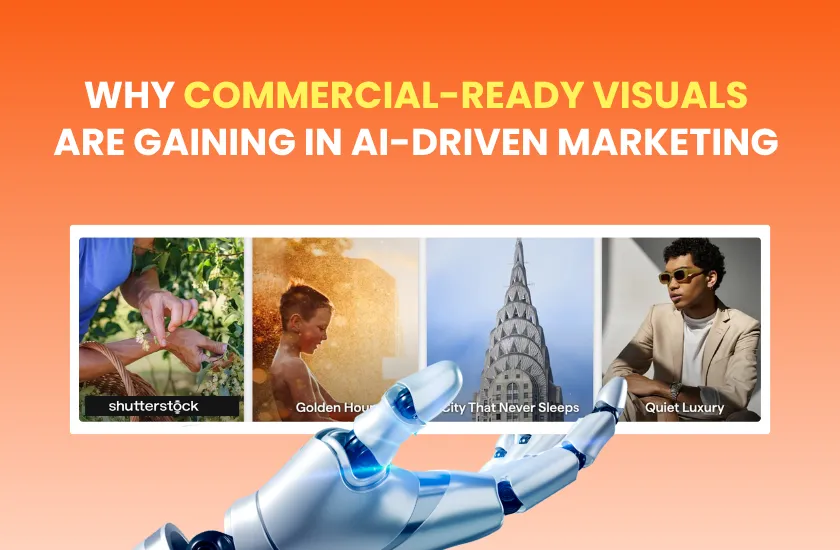
Artificial intelligence has fundamentally changed the speed at which modern marketing teams can produce visual ideas. Where designers once spent hours or days sketching, planning shoots, and coordinating post-production, campaign concepts can now be explored in a matter of minutes. Multiple stylistic variations can be generated almost instantaneously, allowing creators to test directional paths that previously demanded significant manual effort. For modern organizations under constant pressure to publish more content across a growing array of channels, this acceleration represents a substantial operational advantage.
However, the rapid expansion of AI-generated imagery has also exposed a critical distinction in the industry. A visual can be visually impressive, contextually relevant, and technically sophisticated without necessarily being ready for commercial deployment. Once an image moves beyond internal experimentation and becomes an active component of a real, public-facing campaign, a series of rigorous questions immediately come into play. Organizations must ask whether the asset can be used with absolute confidence, whether it faithfully reflects brand identity, whether it can be seamlessly adapted across multiple formats, whether its origin is sufficiently clear, and whether it will work consistently alongside dozens of other assets in a large-scale rollout.
As visual creation becomes easier, these underlying questions are rapidly becoming more important than the generation process itself. The actual value of an image is increasingly determined not by how quickly it can be synthesized, but by how effectively it can enter and survive a professional marketing workflow.
The Supply of Visual Content Is No Longer the Main Problem
For many years, marketing departments struggled primarily with production capacity. Creating enough imagery to sustain active campaigns required extensive photography, design, post-production, location planning, casting models, and complex administrative coordination. Even relatively modest campaigns consumed significant amounts of time and financial resources before a reliable, usable library of visual assets was finally available to the team.
Traditional stock media reduced part of this heavy operational burden by giving brands immediate access to professional content without requiring a dedicated, custom production for every single initiative. Generative AI has now gone significantly further, allowing teams to produce high-level concepts, iterative variations, and entirely new visual directions at unprecedented speeds.
The ultimate result is a complete reversal of the old industry problem. In many modern corporate environments, companies no longer suffer from a shortage of visual options. Instead, they suffer from a distinct excess of them.
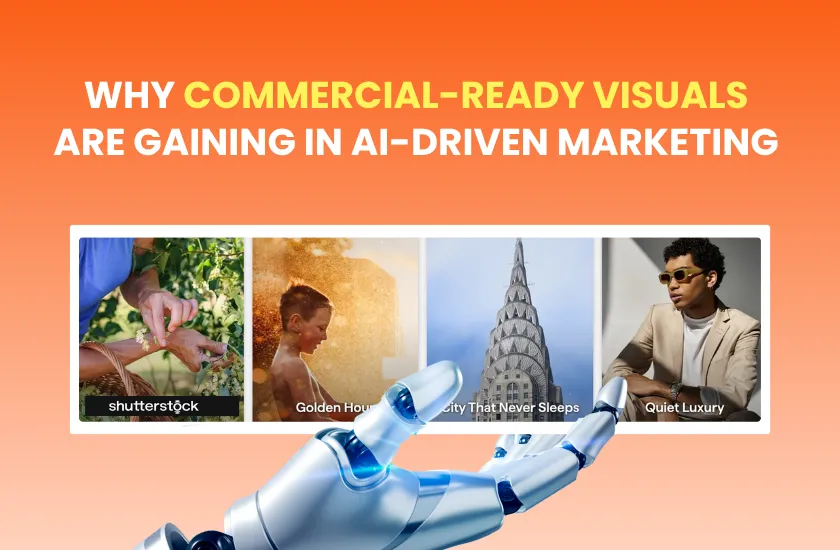
A creative team can now easily generate dozens of competing concepts for a single campaign in the time it once took to prepare a single initial draft. That sheer abundance creates a brand-new operational challenge: choosing which specific assets truly deserve to move forward into production. The more options a team has at its disposal, the more vital evaluation, curation, and strict governance become.
Commercial Marketing Has a Higher Threshold Than Experimentation
Internal experimentation within creative departments is inherently forgiving. A concept image only needs to communicate an abstract idea clearly enough for a team to understand the general direction. It can be imperfect, temporary, structurally flawed, or entirely unsuitable for final public publication.
Commercial campaigns, by contrast, operate under entirely different and much stricter conditions. A visual used publicly may simultaneously appear across paid advertising networks, social media platforms, corporate websites, physical sales materials, and localized regional campaigns. Furthermore, it can remain visible to the public eye for months or even years. Consequently, an organization requires far more than basic aesthetic quality before greenlighting an asset.
These high-stakes considerations are not arguments against the use of AI-generated content. They simply illustrate why raw visual production and commercial deployment should never be treated as the exact same phase of work. The ability to create imagery quickly is undeniably valuable, but the ability to deploy assets with absolute commercial confidence is equally important.
The Meaning of Creative Efficiency Is Changing
Creative efficiency used to be discussed almost exclusively in terms of direct production time. If an image could be successfully created in one hour instead of an entire day, the production process was universally considered more efficient.
Generative AI vastly complicates that traditional calculation. A team might now generate fifty possible campaign images in a remarkably short window of time, but the true operational cost often emerges much later if those generated assets require extensive human review, corrections, reformatting, or total replacement due to hidden flaws or compliance issues. High output volume does not automatically translate to high creative efficiency.

A much more useful definition of modern creative efficiency considers the entire, uninterrupted path from initial concept all the way to final deployment. The strongest workflow is not necessarily the one that manufactures the largest number of raw assets. Rather, it is the one that gets suitable, high-quality assets into the market with the least amount of unnecessary friction.
This reality is one of the primary reasons professional stock platforms continue to matter profoundly in the age of AI. Services such as Shutterstock provide massive, carefully curated collections of professional photography, illustrations, vectors, and video footage created explicitly for commercial use. That gives marketing teams access to reliable source material that can move into a commercial workflow much more directly, while AI tools are deployed to accelerate targeted adaptation and experimentation around that professional foundation.
AI and Stock Media Are Becoming More Complementary
The rapid rise of generative AI has frequently been framed in industry discourse as a direct and existential challenge to traditional stock photography. Skeptics often ask why a marketer would bother searching for an existing image when they can simply generate a custom visual on demand.
That simplistic comparison fundamentally overlooks how real creative teams actually operate day-to-day. Modern marketing production increasingly combines several distinct sources rather than relying on a single method. A comprehensive campaign might utilize AI-generated concepts during the early planning stages, professional photography for key anchor brand visuals, stock content for supporting layout assets, and AI-assisted editing tools to create multiple localized formats.
This blended approach reflects the distinct strengths of each method. AI is exceptionally effective when teams need raw speed, rapid iteration, and wide conceptual experimentation. Professional stock content, meanwhile, provides robust, high-quality source material that already exists safely within a structured commercial and legal environment. The ultimate outcome is not a binary choice between old and new technologies, but rather a sophisticated production model where both elements actively strengthen each other.
Professional Content Can Become a Starting Point Rather Than an Endpoint
The functional role of stock content itself is undergoing a significant evolution. Traditionally, a stock image was frequently treated as the final visual endpoint of a project. A marketer selected an image, licensed it for use, added relevant text or corporate branding, and published it directly.

Modern commercial production is vastly more flexible and interconnected. A single professionally produced image can now serve as the foundational starting point for an entire family of diverse assets. It can be dynamically reframed for social media feeds, adapted for mobile viewports, integrated seamlessly into video sequences, combined with custom illustrations, or used as the visual anchor for several different campaign formats.
AI-assisted editing expands this creative potential even further. Instead of asking whether a stock image is already completely perfect for a final placement, marketing teams can evaluate whether it offers the right subject matter, emotional mood, and visual quality to serve as a strong foundational base. That operational shift grants existing professional content a much longer, highly productive lifecycle within corporate asset libraries.
Provenance Is Becoming a Strategic Consideration
The sheer speed and accessibility of generative AI have brought another complex issue to the forefront of corporate marketing: content provenance. As visual material increasingly originates from a fragmented mix of internal design teams, freelance creators, external agencies, automated AI tools, and professional stock platforms, organizations desperately need clearer internal processes to track where assets came from and under what terms they can be utilized.
This challenge becomes particularly acute at scale. A large global enterprise may operate with dozens of stakeholders across multiple continents, meaning a single multi-channel campaign can contain hundreds of individual assets moving through various approval stages. Without clear, transparent sourcing documentation, even simple administrative questions become extraordinarily difficult to answer later. Teams must be able to verify the exact origin of an image, confirm which specific version was legally approved, understand what licensing conditions apply to its use, and determine whether it can be safely reused in alternative geographic markets.
Established stock platforms have long been structurally built around strict sourcing, copyright clearance, and transparent licensing, giving them a uniquely stable position in increasingly complex modern content ecosystems.
Brand Consistency Is More Difficult When Creation Becomes Unlimited
While AI has dramatically lowered the financial and temporal cost of variation, unlimited visual variation can easily introduce a severe corporate branding problem. A marketing team can effortlessly produce a massive volume of attractive images that, unfortunately, do not feel visually related to one another. Subtle differences in lighting, artistic composition, realism, color palettes, and overall emotional tone can accumulate rapidly across disparate campaigns.

Individually, each generated image may look appealing. Collectively, however, they can dilute and weaken the core visual identity of the brand. Sustainable brand recognition depends heavily on consistency and repetition. Audiences grow to recognize a brand because they repeatedly encounter familiar creative signals, such as signature color schemes, specific photographic styles, intentional framing, and consistent emotional tones.
This dynamic makes curated source material increasingly valuable. Rather than generating every single asset entirely from scratch and risking fragmentation, teams can establish a strong, professional visual foundation and utilize AI strictly to create controlled adaptations that remain within strict brand boundaries. In this model, AI functions as a tool for scaling consistency rather than multiplying chaos.
More Channels Mean More Pressure on Every Asset
The relentless growth of digital channels has exponentially increased the number of distinct operational jobs a single campaign visual must perform. Today, a core creative concept frequently needs to appear as a wide desktop banner, a vertical mobile story, a square social media post, a motion graphic video frame, a programmatic display ad, and a localized print piece all at once.
These diverse formats are rarely interchangeable. A visual composition that performs brilliantly in a wide desktop environment may fail completely when aggressively cropped for a vertical mobile placement. Text requirements shift, aspect ratios change, and critical focal points must be dynamically adjusted.
This environment places an enormous premium on visual assets that can be adapted efficiently and reliably. High-quality stock content provides teams with a structurally sound base from which to build, while AI-assisted tools help extend that content smoothly into the numerous formats required by modern multi-channel campaigns.
Creative Fatigue Makes Reusability More Important
Modern performance advertising introduces yet another persistent challenge: creative fatigue. Even highly successful ad campaigns inevitably lose their conversion effectiveness when target audiences are repeatedly exposed to the exact same visual imagery over extended periods. Consequently, marketing departments require a steady, uninterrupted supply of fresh creative variations without having to constantly rebuild entire campaigns from the ground up.

The standard industry solution is controlled variation. A team can carefully preserve the underlying visual direction of a campaign while altering peripheral elements such as background environments, color grades, or subject placement. This keeps the active advertising recognizable to the consumer while providing enough novelty to prevent audience tune-out.
Professional stock libraries are exceptionally useful in this context because they allow marketers to identify groups of related, cohesive images rather than relying on a single isolated asset. AI can then assist in scaling a wider range of tailored executions from that professional material, resulting in more campaign content that still feels intrinsically connected.
International Marketing Raises the Complexity Further
Global brands face a distinct, high-stakes production hurdle known as localization. A major international campaign must often communicate the exact same strategic corporate message across multiple countries while seamlessly integrating different people, local settings, or culturally appropriate cues. What feels entirely authentic and relatable in one regional market may appear completely unfamiliar or culturally inappropriate in another.
Producing dedicated, original photography from scratch for every single country can be prohibitively expensive. Conversely, generating every regional market entirely independently using unguided tools can introduce severe brand inconsistency.
Professional stock libraries offer a practical middle ground for global organizations. A central international marketing team can source imagery tailored specifically to targeted regions while maintaining a unified, overarching visual style. Large commercial catalogues provide broad coverage across diverse demographics, global industries, distinct locations, and varied lifestyles. AI-assisted editing tools can then help adapt those foundational assets further for local channels and regional formats, making modular localization possible without requiring a complete campaign rebuild.
Human Creative Direction Becomes More Important, Not Less
Although artificial intelligence can produce alternative visual concepts with breathtaking speed, the sheer proliferation of options does not eliminate the fundamental need for human judgment. Human professionals still have to decide which generated visual communicates the core campaign idea most effectively. Someone must still determine whether an asset feels credible, emotionally relevant, and strictly aligned with broader brand values.

These decisions are never purely technical calculations. Professional designers, art directors, and experienced marketers contribute vital contextual awareness, aesthetic taste, and strategic understanding that automated production systems simply cannot provide on their own.
As a result, AI shifts creative labor away from repetitive execution and toward higher-value decision-making. Instead of spending hours on manual production tasks, creative teams can devote their primary attention to careful selection, thoughtful refinement, and strategic direction. The technology multiplies the raw possibilities, but human creativity ultimately determines which possibilities truly matter.
Professional Photography Still Provides a Distinctive Foundation
The rapid technological improvement of synthetic imagery has not erased the enduring commercial value of authentic professional photography. Real photography continues to offer unmatched advantages in sectors where absolute authenticity, trust, and physical reality matter most. Travel, hospitality, culinary arts, lifestyle marketing, corporate communications, and editorial campaigns consistently benefit from genuine locations, deliberate physical lighting, and unscripted human moments.
Professional photographers make complex creative choices that extend far beyond the immediate subject matter. Advanced composition, precise timing, deliberate framing, and authentic environmental detail all contribute to the integrity of the final photograph.
Stock libraries bridge this gap by providing immediate access to vast collections of professionally produced photos and images. Rather than commissioning every single production independently at great expense, brands can leverage existing high-quality material and apply modern technological tools to extend its operational usefulness across campaigns. In this way, AI enhances the flexibility of professional imagery rather than competing with it.
The Best Starting Point Is Often Not Zero
Creative culture has long associated true originality with starting completely from scratch, but commercial marketing operates under entirely different economic and strategic priorities. A final commercial asset is ultimately judged on whether it communicates clearly, fits the established brand guidelines, and successfully supports the overarching campaign objective. The end consumer neither knows nor cares whether an image began its life as a stock photograph, an original photo shoot, a generated AI concept, or a hybrid combination of multiple production methods.
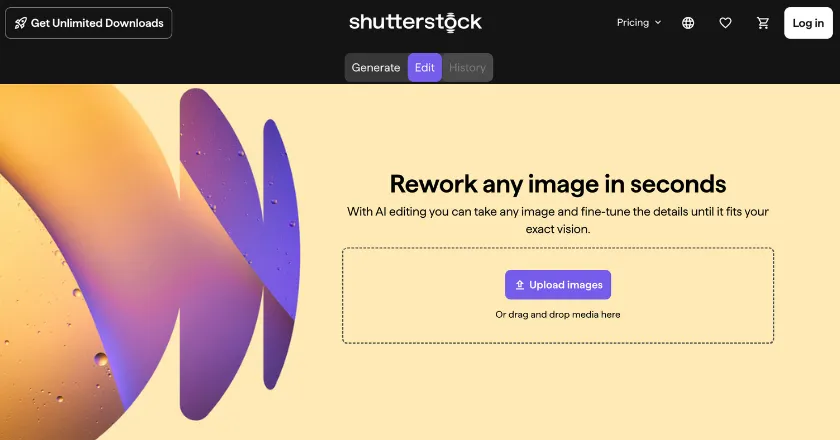
This pragmatic reality fundamentally alters the logic of creative production. If a professionally produced asset already supplies the vast majority of what a campaign requires, recreating that same visual foundation from scratch is often an unnecessary waste of time that fails to improve the final result. A smarter, modern workflow combines multiple methodologies intelligently, drawing on the distinct strengths of professional source material, custom AI generation, and rigorous human art direction.
Commercial-Ready Visuals Could Become More Important as AI Expands
Generative artificial intelligence will undoubtedly continue to reshape the landscape of commercial marketing. Teams will undoubtedly produce greater volumes of imagery, automate repetitive tasks, and generate more versions tailored for diverse audiences and digital channels.
Yet the fundamental requirements of professional commercial communication are not disappearing. Brands still require content they can deploy with absolute legal and aesthetic confidence. Campaigns still require strict visual coherence to build lasting recognition, and marketing departments still require scalable, dependable workflows.
This is precisely why commercially ready visual content is likely to gain even greater value as broader AI adoption accelerates. Professional visual libraries serve as reliable, high-quality foundations that enable faster, safer AI-assisted production. The future of marketing visuals will not be defined by a single source or a single technology, but by a sophisticated hybrid system where professional content, artificial intelligence, and human creative direction work in tandem. As visual creation becomes increasingly effortless, the ultimate challenge for modern marketers will remain deciding what is genuinely worth publishing.
Related News