U.S. Ski & Snowboard Strength Coach Shares Essential Gym Routines to Conquer Mogul Season
Article Editorial Team
Published October 28, 2026
To the casual observer watching from the ski lodge deck, the world’s best mogul skiers make navigating a chaotic field of snow bumps look entirely effortless. They glide down steep fall lines with a fluid grace that masks the immense physical demands of the discipline. But beneath that veneer of calm control lies a punishing athletic reality. Mastering a mogul field requires a specialized blend of explosive power, relentless stamina, and absolute physical precision that cannot be forged simply by logging days on the snow.
According to Maddi Beck, a strength and conditioning coach for the U.S. Ski & Snowboard Team, mogul skiing stands out as a remarkably complex, highly skilled sport. Developing the requisite mastery demands an intense level of precision and technique that athletes can truly only refine by spending long hours on the slopes. However, Beck emphasizes that the discipline also relies heavily on foundational athletic components that can, and should, be systematically trained inside the weight room. These critical elements include robust trunk control, exceptional lower-body muscular endurance, and the capacity to efficiently absorb and rapidly redirect high levels of physical force.
The demand for trunk control in mogul skiing is unique and relentless. In this context, core stability is not merely about holding a plank; it is defined as the ability to keep the torso completely still and stable while the lower body rapidly and abruptly changes directions beneath it. Beck explains that maintaining this upper-body stability allows an athlete to ski with high efficiency. Crucially, it also protects the lower back from absorbing an excessive amount of mechanical stress and impact as the skier’s body pounds continuously over the unforgiving snow bumps. Without this specialized core strength, the spine bears the brunt of the kinetic energy, quickly leading to fatigue and potential injury.
Simultaneously, muscular endurance within the lower body—particularly the quadriceps—is vital for survival and success on a mogul course. Strong quads allow skiers to maintain structural control and withstand the relentless physical impact of continuous bumps run after run. This localized muscular endurance prevents premature burnout, enabling athletes to maintain their speed, form, and tactical line from the top of the course to the bottom. Furthermore, the ability to absorb and quickly redirect force is what enables skiers to execute the lightning-fast directional shifts that define competitive mogul runs.
To bridge the gap between gym training and on-snow performance, Beck has outlined a targeted regimen of seven exercises designed to develop trunk control, lower-body endurance, and force absorption. Integrating these movements into a pre-season workout routine can dramatically enhance athletic performance while simultaneously minimizing the risk of injury when the snow finally starts to fly.
Exercises for Building Trunk Control
Among the core-strengthening protocols Beck develops for elite athletes, including professional skiers and Olympic medalists, two specific movements remain staples across every training program. These exercises address two distinct facets of trunk control: the dead bug, which hones in on foundational core stability, and the Pallof press, which trains the torso to actively resist unwanted rotation. Both the dead bug and the Pallof press can be seamlessly integrated into any standard strength workout, serving effectively as either a neurological activation during the warm-up or as a finishing stability challenge just before the cooldown.
The first movement, the dead bug, requires strict coordination and deep abdominal engagement to keep the spine neutral while opposing limbs move. It teaches the nervous system how to brace the core against external forces, mimicking the stabilization required when a skier’s legs are tossed around by erratic mogul terrain. The second movement, the Pallof press, challenges the oblique muscles and deep stabilizers by forcing the torso to resist rotational torque. This anti-rotation strength prevents a skier’s upper body from twisting open or collapsing when executing sharp turns on steep, icy, or bumpy slopes.
Exercises for Lower-Body Muscular Endurance
To prepare the legs for the grueling demands of continuous downhill pounding, Beck utilizes a specialized mini circuit workout tailored to build muscular endurance, with a primary focus on the quadriceps. For this segment of the training routine, athletes perform a sequence of continuous movements. Each exercise in the circuit is performed for 30 seconds, with the athlete moving directly from one movement to the next without taking any breaks. Once all three exercises in the sequence are completed, the athlete rests for 90 seconds before repeating the entire sequence for a second round, totaling two complete rounds. Beck recommends performing this targeted lower-body circuit one to two times per week.
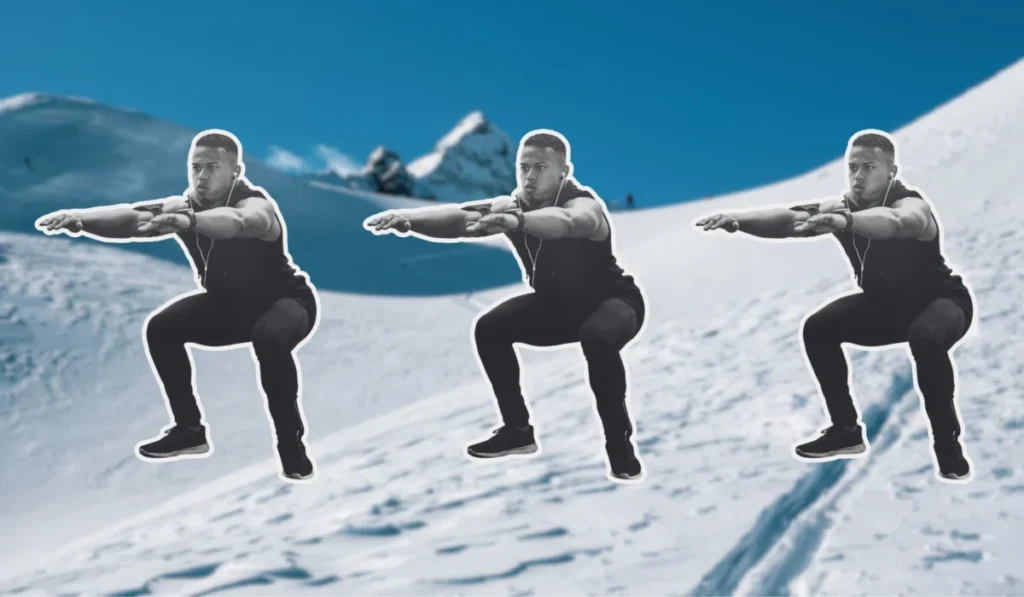
The circuit begins with standard bodyweight squats to establish a baseline of movement mechanics and muscle recruitment. From there, the routine transitions into squat pumps, which keep constant tension on the quadriceps and mimic the micro-adjustments skiers make as they navigate undulating terrain. Finally, the circuit incorporates sustained squat holds, forcing the leg muscles to endure prolonged isometric tension that simulates the sustained lower-body loading experienced during long, aggressive mogul runs.
As athletes adapt to the demands of this initial protocol, the routine can be progressively intensified. Beck suggests gradually working up to a total of five rounds per circuit. Once an athlete masters five rounds, the difficulty can be further increased by introducing a fourth movement, such as explosive squat jumps, into the rotation. When that variation eventually feels manageable, the final progression involves reducing the recovery time between rounds, shortening the rest period from 90 seconds down to 60 seconds to push the limits of local muscular endurance.
Exercises to Improve Power and Force Absorption and Redirection
Beyond endurance and core stability, mogul skiers must possess exceptional power and the physiological capacity to absorb and rapidly redirect high levels of force. Training these qualities requires high-impact plyometric movements. Because these exercises place significant stress on the musculoskeletal system, Beck advises anyone dealing with an active injury to consult a medical professional before attempting them.
These power-focused movements should be incorporated into a weekly training regimen twice a week. To maximize safety and performance, they must be performed at the very beginning of a workout session, immediately following a thorough and deliberate warm-up, ensuring the athlete’s leg muscles are entirely fresh. Training power while fatigued increases injury risk and diminishes the neurological adaptations the exercises are designed to elicit.
When setting up plyometric training, Beck strongly recommends using a soft box rather than a traditional wooden or metal platform, provided one is available. A soft box is significantly more forgiving on the body if an athlete misjudges a jump and catches a toe on the edge during landing.
The plyometric progression begins with box jumps, which can be gradually advanced from initial mastery to three sets of five repetitions. Following the box jumps, athletes incorporate depth jumps, starting conservatively and working up to two sets of five repetitions.
To continually challenge the neuromuscular system and improve force mitigation, Beck outlines a specific progression model for these jump exercises. Training should always begin with a soft landing style, which disperses kinetic energy gradually and is much gentler on the joints. Once an athlete has successfully adapted to landing softly on a taller box height, the training cycles back to a lower box height, where the focus shifts to stiff landings. Stiff landings require the body to absorb impact much more rapidly, building the resilience needed for violent terrain interactions. From there, the box height is gradually increased again. Once that elevated height becomes manageable, the athlete progresses to single-leg soft landings on a low box, eventually working their way up over time to single-leg stiff landings on a tall box.
Don’t Forget to Do Regular Mobility Work and Conditioning
While targeted strength and plyometric training form the bedrock of pre-season preparation, Beck emphasizes that mogul skiers cannot neglect broader cardiovascular conditioning and comprehensive joint mobility. These auxiliary training components are essential for maintaining overall physical resilience throughout a demanding winter season.
Cardiovascular conditioning remains a heavily prioritized element within the U.S. national ski team’s training philosophy. Beck explains that strong aerobic and anaerobic conditioning allows athletes to ski longer, more demanding days on the mountain without suffering from catastrophic drops in physical performance. Crucially, maintaining high conditioning levels helps skiers retain proper technical form even when physical fatigue begins to set in, which serves as one of the most effective lines of defense against injury. While there are numerous ways to build this requisite work capacity, Beck generally recommends incorporating regular endurance sessions, such as bike rides, hikes, or runs lasting 45 minutes or longer, into the weekly schedule.
Equally important is dedicated ankle and hip mobility work. Optimal range of motion in the ankles and hips directly influences a skier’s ability to delicately control their equipment and stabilize their trunk, both of which play a pivotal role in injury prevention. Because of its critical importance, Beck integrates mobility drills into every single workout she programs for her athletes, while also instructing them to dedicate personal time to mobility work outside of structured team sessions.
Related News