How the 34-Inch Economy Seat Became Premium Economy: Inside Modern Cabin Economics
Article Editorial Team
For years, a standard economy class seat featuring 34 inches of pitch represented a dependable, reasonably comfortable way to fly long-haul. It gave passengers enough room to stretch their legs and shift positions during lengthy international flights without requiring them to pay the substantial financial premium associated with business class. Today, however, finding that kind of generous spacing in a standard long-haul economy cabin has become increasingly difficult. Across much of the commercial aviation industry, a seat pitch of 30 or 31 inches has firmly established itself as the new baseline for standard economy services.
As a result, the additional room that once helped define conventional flying is now routinely marketed as a dedicated premium product. This sweeping transformation is not simply a straightforward story of airlines squeezing more passengers onto aircraft, though cabin density remains a primary operational metric. Instead, it reflects a much broader, fundamental shift in airline economics.
Specifically, revenue per square foot has become the guiding principle for how modern aircraft cabins are designed and how comfort is ultimately priced. Premium economy has consequently evolved from a niche upgrade for occasional travelers into something closely resembling yesterday’s standard economy class. Meanwhile, at the opposite end of the pricing spectrum, basic economy has helped create a sharply polarized onboard experience, changing how millions of passengers navigate long-haul travel.

The Disappearing 34-Inch Economy Seat Pitch
Seat pitch measures the distance between corresponding points on two seats in successive rows rather than the physical, unobstructed space available directly in front of a passenger’s knees. Even so, it remains one of the most reliable and transparent indicators of how an airline allocates its valuable cabin space. A 34-inch seat pitch was once heavily associated with relatively generous economy class seating, particularly on long-distance international routes where comfort directly influenced carrier selection.
By contrast, contemporary aircraft configurations commonly place passengers approximately 30 to 32 inches apart, depending heavily on the specific airline, aircraft type, and route network. While the difference between 34 inches and 30 inches might initially appear numerically insignificant, losing those crucial four inches can materially alter the experience of sitting upright for ten or twelve hours. This compression is especially challenging for taller passengers, whose knees often come into direct contact with the seatback pocket ahead of them before the boarding door is even closed.
While a 31-inch configuration represents a slightly smaller reduction, the cumulative effect remains highly noticeable. Passengers frequently find themselves unable to stretch comfortably, change positions easily, or find a truly relaxed posture during overnight journeys. Aircraft type also plays a critical role in this dynamic, because cabin width, specific seat design, and the number of seats installed abreast across each row heavily influence the overall perception of space.

Among the majority of major network carriers, including American Airlines and United Airlines, the Boeing 787 Dreamliner typically features a 3-3-3 layout in economy class, whereas the wider Boeing 777 can accommodate an extra seat per row in a denser 3-4-3 layout. Furthermore, a clear distinction exists between the raw space an airline provides on paper and the actual space passengers experience in flight. Identical pitch measurements can yield vastly different levels of comfort depending on modern seat thickness, integrated recline mechanisms, and cushion design. Nevertheless, the broader industry trend remains unmistakable: passengers increasingly encounter less room in standard economy while paying separately for the additional space that once formed the baseline of a conventional ticket.
The Economics Behind the Smaller Seat
The underlying explanation for shrinking legroom lies squarely in the economics of aircraft interiors, where every additional inch of cabin space carries a distinct opportunity cost. That space could otherwise accommodate another paying passenger or contribute to a higher-value seating arrangement. Airlines constantly balance complex operating expenses, aircraft utilization rates, shifting passenger demand, and volatile ticket revenues. Even minor adjustments to a cabin layout can significantly influence how much revenue an individual aircraft generates on each departure.
Business class illustrates this financial incentive with striking clarity. A premium business class seat can easily occupy two to four times the physical floor space of a standard economy seat while commanding a fare many times higher. Industry estimates suggest that business class cabins can generate four to five times as much revenue per square foot as economy class. Meanwhile, premium economy can deliver approximately 1.8 to 2.4 times the revenue of economy while utilizing only about 1.5 times the physical footprint.

These financial estimates naturally vary by route, aircraft type, and seasonal demand fluctuations, but they thoroughly explain why airlines increasingly prioritize a carefully calibrated cabin mix over simple passenger volume. Selling fewer seats at significantly higher prices can often generate superior financial returns than maximizing sheer capacity, particularly on high-demand routes where corporate travelers and affluent leisure passengers demonstrate a strong willingness to pay for added comfort.
The ultimate result is a commercial calculation favoring high-yield premium seating alongside a densely configured economy cabin. This creates what industry analysts frequently describe as a barbell-shaped aircraft interior. Business class successfully captures passengers paying substantial sums for absolute privacy and luxury, while economy class retains budget-conscious travelers seeking competitive fares. This leaves premium economy positioned neatly in the middle to capture those passengers willing to spend more for comfort without stepping up to a fully lie-flat business class product.
Premium Economy Becomes the New Normal
When it was first introduced, premium economy was positioned as an intermediate option for travelers who wanted an elevated experience compared to standard economy but could not justify the steep prices of business class. Its initial appeal rested on wider seats, additional legroom, enhanced recline angles, and selected service improvements. This allowed airlines to sell a meaningful upgrade without dedicating as much valuable floor space to each individual passenger as business class requires.

As major carriers continued to refine their onboard offerings, however, premium economy transitioned from a collection of comfortable seats into a distinct, highly profitable revenue category. On modern long-haul aircraft such as the Airbus A350, premium economy cabins often provide a quieter, more intimate environment, improved catering, and priority airport services alongside their physical advantages, though the exact package varies significantly by airline.
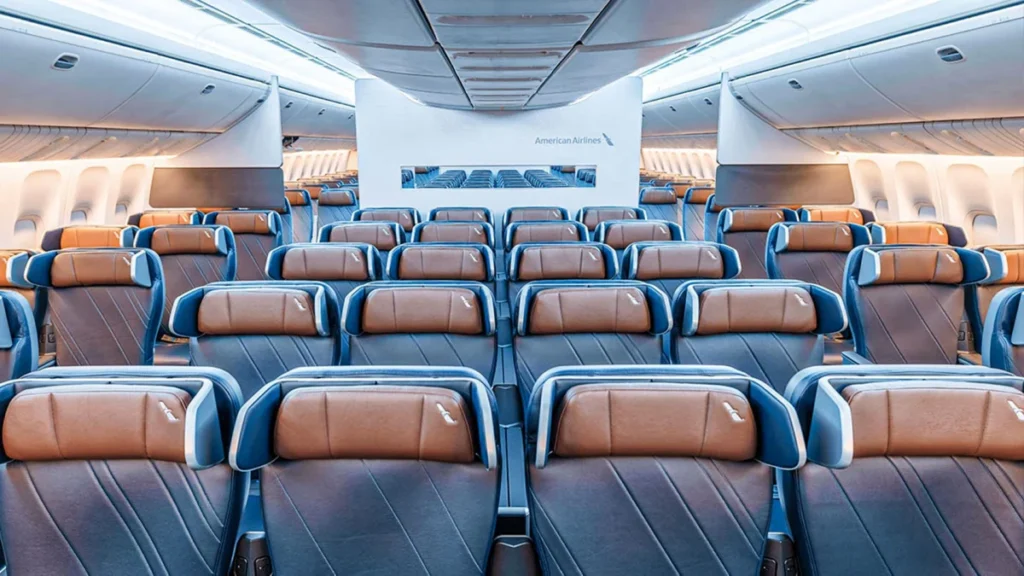
The prevailing irony is that some of the physical room passengers now pay extra to obtain closely mirrors the space available in older, traditional economy configurations. Premium economy seats frequently provide pitches in the mid-to-upper 30-inch range, bringing them much closer to traditional expectations of standard seating than the increasingly common 30- or 31-inch economy layouts found across modern fleets.
For airlines, this structure creates an ongoing opportunity to monetize comfort without raising ticket prices across the board. Passengers who prioritize legroom can actively purchase an upgrade, while price-sensitive travelers remain in standard economy or choose basic economy. This commercial strategy effectively captures varied consumer willingness to pay, but it also means that the baseline comfort once associated with an ordinary ticket now heavily depends on selecting the correct fare category.

Premium Revenue is Challenging Economy Class
The financial importance of premium seating has grown in tandem with expanding premium cabins, particularly among major United States carriers fiercely competing for corporate accounts and affluent leisure travelers. Premium customers routinely generate disproportionately high revenue through expensive tickets, paid upgrades, and a greater readiness to spend on itinerary flexibility, convenient schedules, and onboard comfort. This economic reality encourages airlines to dedicate progressively more aircraft floor space to these high-yield travelers.
Delta Air Lines provides a striking illustration of this ongoing shift. Premium ticket revenue reached approximately $6.82 billion in the third quarter of 2026, narrowly surpassing the $6.80 billion generated by its main cabin during the same period. These figures vividly demonstrate how significant premium demand has become for a major legacy carrier, though a single quarterly result does not establish that every airline or route has achieved the exact same balance.
Other major network carriers similarly illustrate the intense competitive pressure to differentiate their cabin products. American Airlines and United Airlines both offer robust premium cabin options designed to attract customers far beyond the traditional economy market, while their long-haul fleets compete vigorously for passengers carefully comparing comfort, flight schedules, and total ticket costs.

Overall capacity trends reinforce this broader structural shift. United States premium seat capacity has reportedly increased by 33% since 2020, compared with just 16% growth for standard economy capacity. This faster rate of expansion clearly signals that airlines are increasingly prioritizing cabin products capable of generating higher financial returns from restricted aircraft space, though the practical consequences for individual travelers depend heavily on the specific route, aircraft configuration, and available travel alternatives.
Basic Economy Completes the Barbell
Basic economy class represents the opposite side of this comprehensive commercial strategy, allowing airlines to advertise lower entry-level fares while restricting standard benefits that passengers might once have taken for granted on a conventional economy ticket. Depending on the specific carrier and itinerary, these restrictions can involve prohibiting advance seat selection, restricting ticket changes, removing boarding priority, or limiting baggage allowances, effectively turning the cheapest fare into a deliberately stripped-down product.
This pricing strategy helps network carriers successfully compete with ultra-low-cost carriers without reducing the baseline price of every single seat on the aircraft. Customers who are concerned primarily with minimizing upfront costs can select the restricted fare, while other travelers pay more for flexibility and everyday convenience. It also generates valuable ancillary revenue when passengers later purchase preferred seat assignments, checked bags, or other onboard services separately.

Together, basic economy and premium economy establish a much more pronounced cabin hierarchy. A stripped-down entry product sits at one end, while a more spacious and expensive alternative rests at the other. Standard economy sits squarely between them, but its traditional role as a reasonably comfortable default has become less straightforward as airlines aggressively differentiate seating dimensions, legroom allowances, and accompanying services.
This evolutionary approach does not mean every single airline is deliberately reducing every aircraft seat’s pitch, nor does it imply that all economy cabins are uniformly restrictive. Rather, it demonstrates how advanced pricing segmentation allows modern carriers to sell widely different levels of comfort and convenience within the exact same aircraft hull, making thoughtful cabin design completely inseparable from the broader corporate strategy of maximizing overall revenue.
What Passengers Should Check Before Booking
Passengers comparing economy class fares should carefully examine actual seat pitch, seat width, and fare restrictions rather than relying exclusively on the advertised ticket price. The cheapest upfront option can quickly become less attractive once mandatory seat selection fees and baggage costs are factored in, while a tight 30-inch pitch can feel particularly restrictive on an overnight journey compared to a more generous configuration.

Premium economy warrants closer scrutiny when the price difference over standard economy is reasonable, but the marketing label alone does not guarantee a uniform product across different carriers. Some airline cabins provide genuinely wider seats, greater recline capabilities, and meaningful service enhancements, while others deliver a more limited upgrade centered primarily on additional legroom and a modest selection of amenities.
Travelers should also verify the precise aircraft assigned to their specific flight, because interior configurations can vary significantly even within the same airline and aircraft family. A Boeing 787 operating a long-haul service may offer a markedly different seating experience than another aircraft operating on the same route, making published seat maps and specific cabin details far more useful than general assumptions about an airline’s entire fleet.
Finally, premium economy pricing can occasionally function as a commercial decoy when its fare appears attractive next to an expensive economy ticket yet sits surprisingly close to business class. Comparing all available cabins, including their respective baggage allowances, change flexibility, and seating arrangements, helps reveal whether a particular upgrade represents genuine travel value or simply another carefully calibrated price point in an increasingly segmented aviation market.
Related News