Breeze Airways Validates Its Underserved Route Model With a Massive 19-Route July Expansion
Article Editorial Team
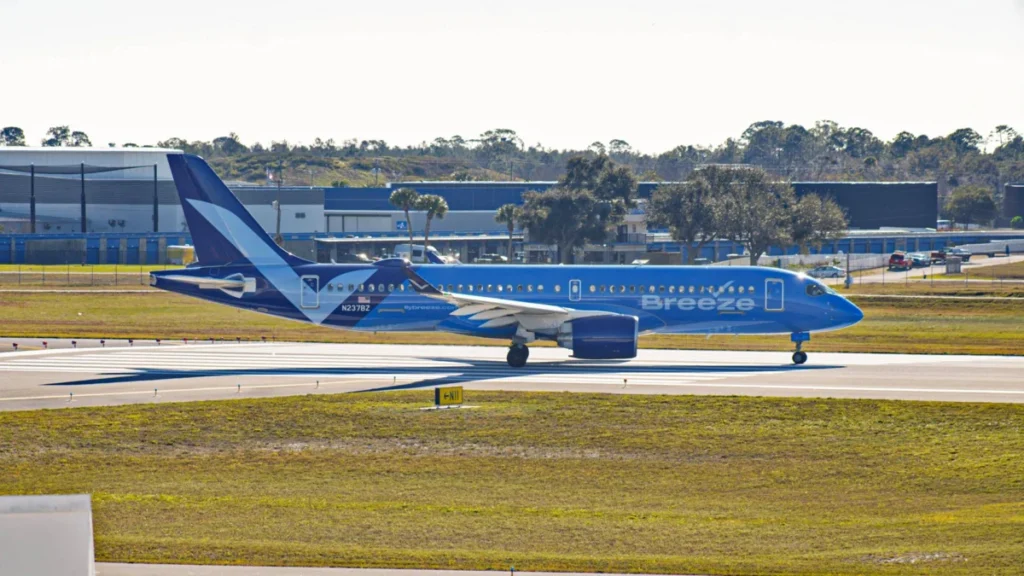
Launching 19 new and returning routes in just 72 hours would be an exceptionally ambitious move for any commercial carrier in the modern aviation landscape. However, for Breeze Airways, this rapid network expansion represents far more than simply adding new dots to a map. Instead, it serves as a powerful validation of a unique business model that many industry observers once questioned. Between July 1 and July 3, the airline significantly broadened its domestic network by introducing a wave of routes connecting smaller secondary and tertiary United States cities, pushing its operational footprint to new heights.
This intense three-day rollout propelled the carrier’s July schedule to approximately 266 daily departures, marking a staggering 44% increase compared to the same month a year earlier. Underpinning this aggressive growth is founder and CEO David Neeleman’s core philosophy that Breeze can profitably serve regional markets generating as few as 10 passengers per day each way.
This counterintuitive strategy explains why Breeze continues to target city pairs that are largely ignored by major legacy airlines and ultra-low-cost competitors alike. Of the 19 routes launched during this compressed 72-hour window, an impressive 13 operate entirely without any direct nonstop competition. Furthermore, several of these new additions successfully restored vital regional connectivity that had been abruptly lost earlier in the year when Spirit Airlines ceased operations. Rather than slugging it out on crowded, low-yield hub-to-hub corridors, Breeze is utilizing the advanced capabilities of the Airbus A220 to bridge the gap between secondary airports, creating a niche network built around markets with limited competition and stable local demand.

Breeze’s July Expansion Focused On Underserved Cities
The coordinated July network expansion stands as one of the largest simultaneous rollouts in Breeze Airways’ history since the carrier officially commenced flight operations in 2021. Introducing 19 new and returning routes in the span of just three days amounts to more than six route launches every 24 hours, reflecting the blistering pace at which the airline has continued to scale its operations across the country.
By July 2026, Breeze’s daily operations had swelled to around 266 aircraft movements, representing a year-over-year jump of roughly 44%. Rather than pouring capacity into congested mega-hubs, the airline has concentrated much of this network expansion around secondary facilities. Fort Lauderdale, for instance, gained several new nonstop destinations during this latest push.
At the same time, the introduction of first-ever nonstop city pairs—such as the link between Akron-Canton Airport (CAK) and Portland International Jetport (PWM), or the connection linking Fort Lauderdale-Hollywood International Airport (FLL) with Salisbury-Ocean City-Wicomico Regional Airport (SBY)—illustrates the airline’s distinct appetite for entering markets that previously lacked any direct scheduled commercial service. Industry tracking indicates that across the 19 additions, roughly 68% are monopoly routes. This deliberate positioning allows Breeze to avoid direct competition on the vast majority of its newest services, establishing a stark contrast to legacy carriers that typically deploy large mainline aircraft where raw passenger volumes are highest.

Instead of fighting for market share where passenger traffic is already heavily saturated, Breeze actively searches for city pairs with enough local demand to support a modest, low-frequency schedule—even if that baseline traffic falls well below the high thresholds traditionally demanded by larger network airlines. The resulting network continues to expand organically, entirely avoiding the operational bottlenecks of congested hub airports and fierce trunk-route price wars.
What Does ’10 Passengers Per Day Each Way’ Actually Mean?
CEO David Neeleman’s oft-repeated claim that Breeze can successfully turn a profit in markets with just 10 passengers per day each way is frequently misunderstood by casual observers and aviation analysts alike. The figure does not mean that individual flights depart with a meager total of only 10 passengers onboard. Rather, it serves as a statistical metric measuring the average number of people traveling between two specific cities on a typical day, regardless of which airline they currently patronize or whether they are forced to endure cumbersome layovers by connecting through a major hub.
A market that produces 10 passengers in each direction every single day generates approximately 140 one-way passengers over the course of a week. If Breeze strategically schedules only three weekly round trips on that specific city pair, those travelers are concentrated onto a handful of well-timed departures instead of being diluted across seven daily flights.

Before even accounting for newly stimulated demand, seasonal vacation peaks, or regional travelers who previously avoided taking trips altogether because no convenient nonstop option existed, this dynamic already translates into a far healthier passenger load factor per flight than many critics initially assume. This crucial mathematical distinction forms the bedrock of Breeze’s long-term network planning philosophy. While traditional hub-and-spoke airlines often require immense volume to justify multiple daily frequencies, Breeze only requires enough cumulative weekly demand to support a small, highly efficient schedule of nonstop flights. This approach unlocks hundreds of overlooked markets where everyday passengers place a high value on personal convenience over flight frequency, opening up commercial opportunities that major legacy operators routinely dismiss as too small to bother with.
Why The Airbus A220 Makes These Routes Viable
The execution of Breeze’s innovative network strategy would be practically impossible without the operational flexibility provided by the Airbus A220-300. Configured with a comfortable 137-seat layout, the aircraft brilliantly combines remarkably low per-trip operating costs with a robust range of approximately 3,450 nautical miles. This impressive operational range enables nonstop services between domestic secondary cities that previously required multi-leg journeys and connections through major metropolitan hubs.
These aircraft capabilities allow Breeze to operate longer domestic sectors without introducing larger, fuel-guzzling, and financially riskier mainline aircraft. Equally critical to the airline’s business model are the exceptional economics delivered by the A220’s powerplants. Powered by Pratt & Whitney PW1500G geared turbofan engines, the aircraft consumes significantly less fuel per seat than older single-aisle jets of comparable size while simultaneously lowering routine maintenance overhead and reducing airport-related gate and parking costs.

Crucially, it is the lower absolute trip cost—rather than simply a lower cost per available seat mile—that empowers Breeze to schedule flights just a few times each week without needing astronomical passenger volumes to break even. Furthermore, revenue generation for the airline extends well beyond basic ticket sales. Unlike typical low-cost carriers that rely entirely on a single cabin class, Breeze features a dedicated premium cabin known as Ascent, alongside bundled fare classes, optional seat selection fees, checked baggage charges, and other ancillary products. These diversified revenue streams successfully improve overall yields and help subsidize operations in smaller regional markets where total passenger counts may be limited, yet travelers are more than willing to pay a fair premium for the undeniable convenience of a direct flight.
Industry Changes Have Created Thousands Of New Opportunities
Breeze’s aggressive expansion has unfolded against a backdrop of sweeping structural changes across the broader United States airline industry. Over the past decade, major network carriers have increasingly hyper-focused their capacity around massive hub operations while systematically cutting back or entirely abandoning service to smaller regional airports. Concurrently, the industry-wide retirement of numerous aging 50-seat regional jets has made it economically unviable to serve lower-demand destinations using traditional regional airline operating models.
Routes that were once economically supported by these smaller regional aircraft frequently cannot sustain the larger regional jets or mainline narrowbody jets that have since replaced them, forcing many mainline carriers to pull out of smaller communities altogether. The high-profile collapse of Spirit Airlines accelerated these industry shifts by instantly leaving numerous regional city pairs completely devoid of nonstop service.

Although Breeze does not directly replicate Spirit’s ultra-low-cost, high-density operational approach, the carrier has been uniquely positioned to step into these underserved markets where genuine passenger demand already existed, but direct airline competition had entirely vanished. This dynamic has enabled Breeze into established regional travel markets without getting bogged down in destructive fare wars.
Secondary and tertiary airports also deliver substantial operational advantages that extend far beyond a lack of airline competition. Lower landing fees, significantly shorter aircraft taxi times, and minimal air traffic congestion allow the carrier to maximize daily aircraft utilization while keeping schedule delays to a minimum. For everyday passengers, these smaller regional facilities frequently translate into shorter security screening queues, hassle-free parking, and much faster journeys from the terminal entrance to the aircraft door, making infrequent nonstop flights far more appealing than fighting the crowds at a massive hub.
Why Less Competition Can Mean Higher Profits
One of the defining characteristics of Breeze’s July expansion wave was the remarkable absence of direct head-to-head competition. Out of the 19 routes launched during the initial three-day push, 13 are operated exclusively by Breeze, meaning nearly 68% of the new services face zero direct nonstop competition from any other commercial airline. Rather than aggressively wrestling for market share on heavily contested corridors, the airline is frequently establishing a brand-new nonstop market from scratch.

This lack of immediate rivals allows the carrier to capture local passengers who would otherwise be forced to endure lengthy connections through major hubs or abandon travel plans entirely. Limited competition also grants Breeze much greater pricing flexibility than airlines operating on crowded, commoditized routes. While ticket prices must always remain attractive enough to stimulate local demand, the airline is far less vulnerable to predatory price matching from larger legacy competitors.
This pricing insulation exists because regional travelers inherently value the immense time savings and sheer convenience of a nonstop flight. For passengers residing in smaller cities, eliminating a layover can shave several hours off a total travel day, making a modest fare premium exceptionally easy to justify. Operating monopoly routes also yields hidden marketing efficiencies; advertising costs tend to be lower because Breeze is introducing an entirely novel travel option rather than trying to convince loyal flyers to switch airlines, and flight schedules can be tailored directly to local community needs rather than reactionary competitor timetables. Combined with the intrinsic cost advantages of the Airbus A220, this creates a resilient business model focused heavily on sustainable financial returns across hundreds of overlooked markets.
Breeze Has Only Scratched The Surface Of Its Potential Network
Perhaps the most striking figure highlighted by leadership is the estimate that approximately 3,500 domestic US city pairs generate sufficient underlying demand to successfully support Breeze’s specialized operating model. Because the airline currently serves roughly 280 of those potential markets, it has tapped into only about 8% of what management projects as its ultimate long-term addressable opportunity.

Even when accounting for future market overlap and potential competitor intrusion, these projections point toward a vast runway for continuous, measured network expansion. Backing this long-term ambition is Breeze’s rapidly growing fleet of Airbus narrowbody aircraft. The airline currently operates more than 50 A220s, with dozens of additional firm orders scheduled for delivery from the manufacturer over the coming years.
Each newly delivered aircraft provides management with the operational flexibility required to either launch brand-new unserved routes or increase flight frequencies in markets that have already demonstrated stronger-than-expected local demand. This overarching corporate strategy reflects a fundamentally different perspective on domestic aviation growth. Rather than going toe-to-toe against the largest US airlines on saturated trunk routes, Breeze is methodically building enterprise value and scale through hundreds of individually modest regional markets that collectively represent millions of annual travelers. As this niche-focused approach continues to prove its financial viability, the airline’s expansive July network rollout may ultimately be remembered less for the sheer number of routes it introduced in 72 hours, and more for proving that sustainable, profitable aviation growth does not exclusively require serving the nation’s busiest airports.
Related News