Navigating Visual Content Rights: Why Licensed Media Remains Essential in the Age of Generative AI
Article Editorial Team
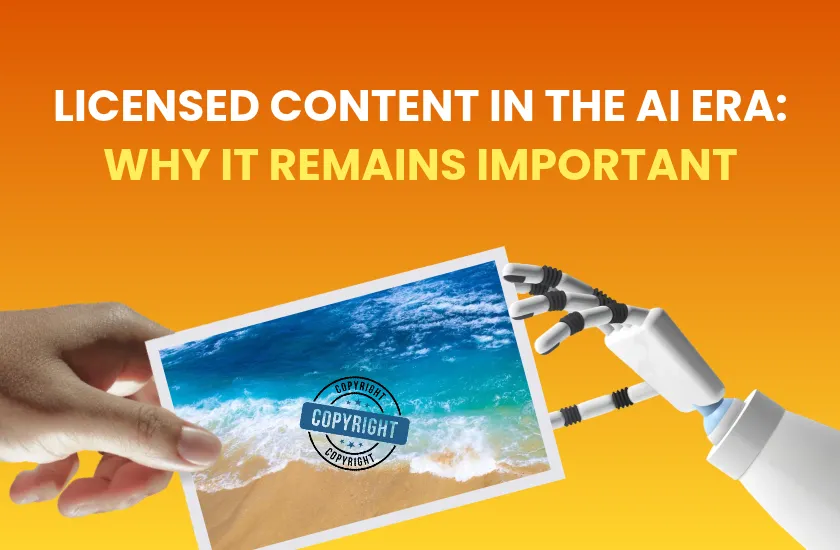
Artificial intelligence has fundamentally transformed how businesses and marketing teams create visual content. Rather than spending hours searching through hundreds of stock photographs or commissioning expensive custom illustrations, creative professionals can now generate bespoke images simply by typing text instructions into a platform.
While these generative tools offer significant advantages in terms of speed, cost-efficiency, and flexibility, they also introduce complex questions regarding commercial usage rights, ownership, and legal responsibility. As companies increasingly integrate AI-generated visuals into advertising campaigns, website content, and branded materials, the fundamental question of an asset’s origin remains an important consideration. This landscape highlights why licensed creative assets continue to serve a valuable purpose, even as AI-generated graphics become increasingly common across the digital media ecosystem.
Understanding the Role and Boundaries of Content Licensing
A content license is a formal agreement that establishes the conditions under which creative material can be legally used. Depending on the specific terms of the contract, these conditions typically address commercial distribution rights, permissible modifications, geographic restrictions, and approved publication channels. Such licensing arrangements apply broadly across various forms of media, including stock photography, digital illustrations, video footage, audio recordings, and graphic elements.
One frequently misunderstood concept within the industry is royalty-free licensing. Despite its name, royalty-free content is not necessarily available without payment or restrictions. Instead, the term generally refers to a specific licensing model that allows specified uses of an asset without requiring recurring royalty payments for each individual publication or impression.
Importantly, acquiring a license for an asset does not mean acquiring the underlying copyright itself. The original creator typically retains full ownership of the work while granting the customer specific, limited permissions for use. For corporate marketing departments, understanding this fundamental distinction helps prevent costly misunderstandings when creative assets are repurposed, archived, or distributed across new channels.
AI Imagery Creates New Opportunities and New Responsibilities
Generative AI provides a compelling alternative to conventional image sourcing, allowing businesses to rapidly develop visual concepts, experiment with intricate compositions, and produce customized graphics without relying exclusively on existing image libraries. However, gaining access to an image-generation platform does not automatically resolve every legal and operational question surrounding the resulting content. Several critical considerations deserve particular attention from corporate legal and creative teams.
Commercial permissions vary widely, as AI providers establish their own distinct terms governing how generated content may be deployed. These conditions can differ substantially between platforms, subscription tiers, and enterprise services. Furthermore, copyright protection for AI-generated works depends heavily on applicable regional laws and the extent of human creative involvement. In the United States, for example, the Copyright Office has consistently emphasized the importance of human authorship when evaluating the eligibility of AI-assisted works for copyright registration.
Additionally, generated visuals may inadvertently contain elements resembling recognizable individuals, protected corporate brands, or existing creative material. Securing permission from an AI service provider does not automatically eliminate potential third-party intellectual property claims. Businesses also must recognize that AI-generated imagery is rarely exclusive; companies should not assume that a generated output is entirely unique or that other users cannot inadvertently create strikingly similar visuals using the same prompts.
These considerations do not make AI unsuitable for commercial design; rather, they highlight the necessity of carefully evaluating generated content before incorporating it into publicly distributed materials.
Where Licensed Stock Media Offers Practical Advantages
Even with the rapid evolution of advanced image-generation technology, professionally licensed media provides distinct practical benefits for companies and creative professionals. Stock media licenses allow businesses to examine the precise permitted uses of an asset before including it in a project. This clarity is particularly valuable for multi-channel campaigns distributed simultaneously across corporate websites, digital advertisements, email newsletters, and printed promotional materials.
Nevertheless, precision regarding license conditions remains essential. For instance, images explicitly designated for editorial use generally cannot be treated as cleared for conventional commercial advertising purposes.
Organizations also frequently manage extensive digital asset management collections comprising thousands of photographs, videos, and design elements. Keeping accurate licensing information alongside individual assets simplifies internal reviews and client handovers. Teams can document the content provider, the applicable agreement, purchase information, and the specific project in which an asset was deployed. This meticulous documentation becomes critically important when older campaign materials are updated, transferred to an external agency, or published again years later.
Furthermore, while AI can generate convincing representations of people, environments, and products, businesses often require authentic photographs showing actual locations, verifiable products, or real-world events. Professionally produced stock photography and footage meet these demands while ensuring consistent brand presentation. Creative teams can thus select between generated media and traditional stock assets based on the unique requirements of each individual assignment.
Licensing also provides vital financial support to the broader commercial ecosystem surrounding photography, illustration, and video production. Professional creators invest substantial time, specialized equipment, and artistic expertise into producing visual assets, and licensing revenue directly sustains their livelihoods. However, a clear legal distinction exists between licenses for ordinary media usage and agreements covering machine-learning applications. The right to include a photograph in a marketing campaign does not automatically confer permission to use that same photograph for training AI models.
Combining AI Technology With Licensed Creative Assets
Rather than viewing the shift as a binary choice between traditional stock media and generative AI, many organizations find that combining both approaches offers the greatest flexibility. In a typical modern workflow for a digital advertising campaign, a design team might begin by licensing a professionally produced photograph that accurately reflects the intended audience and brand positioning.
AI tools can then support the subsequent development of alternative headlines, initial layout concepts, or other creative variations around that core visual element. This hybrid approach enables teams to leverage the efficiency of automation while retaining a clearly documented, reliable source for primary visual elements. Any AI-assisted modification of a licensed asset, however, must still comply with the terms of the original license as well as the rules governing the editing software.
Shutterstock and the Evolving Role of Stock Platforms
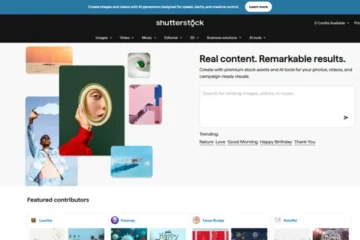
Platforms such as Shutterstock remain central resources for organizations seeking professional visual content alongside newer AI-based creation capabilities. These platforms provide access to millions of licensable photographs, illustrations, and video media formats, typically structured around tiered options such as Standard and Enhanced licenses that outline specific commercial permissions and limitations.
Alongside conventional stock licensing, major providers have introduced AI-powered creative tools and separate data-licensing offerings specifically tailored for machine-learning applications. Initiatives such as Contributor Funds are often associated with these data-licensing and generative-AI activities, compensating creators whose work supports technological development.

However, businesses must evaluate the conditions applicable to each service individually. The availability of a commercial license or access to an AI creation tool should never be interpreted as an unconditional legal guarantee against every possible intellectual property dispute.
The Impact of AI Regulation on Creative Content
The legal environment surrounding artificial intelligence continues to evolve rapidly as governments worldwide introduce comprehensive rules addressing AI systems and their commercial applications. In the European Union, the Artificial Intelligence Act establishes strict requirements affecting certain AI providers, including mandatory copyright-related policies and detailed summaries of training content used for general-purpose AI models, subject to applicable jurisdictional scopes.
Industry observers emphasize that these emerging regulatory requirements should not be confused with a universal obligation to purchase stock media licenses for every AI-generated marketing image. Similarly, obtaining permission to use content commercially under a software platform’s contractual terms is not legally equivalent to securing copyright ownership. Businesses operating internationally must carefully consider both the contractual conditions tied to their creative tools and the broader legal frameworks governing their intended markets.
Ultimately, while artificial intelligence has fundamentally expanded the possibilities for visual content production, the ability to generate an image quickly does not equate to holding all the rights necessary to publish, modify, or distribute it. Licensed creative content continues to offer enduring practical value through defined usage conditions, traceable permissions, and access to authentic, professionally produced media. By selecting creative resources according to specific project requirements, reviewing relevant terms, and maintaining clear documentation throughout the production process, organizations can successfully navigate the complexities of the modern digital media market.
Related News