CoStar and Tourism Economics Upgrade U.S. Hotel Forecast for 2026 and 2027 Amid Robust Travel Momentum
Article Editorial Team
ARLINGTON, Virginia—In their final forecast revision of the year, industry analysts CoStar and Tourism Economics have delivered a notable vote of confidence in the American hospitality sector, implementing significant upward adjustments to their growth projections for both 2026 and 2027. The latest data points to unexpected resilience in consumer demand, strong autumn travel patterns, and a broader macroeconomic environment that continues to defy persistent headwinds, setting the stage for what could be historic performance benchmarks across the domestic lodging industry.
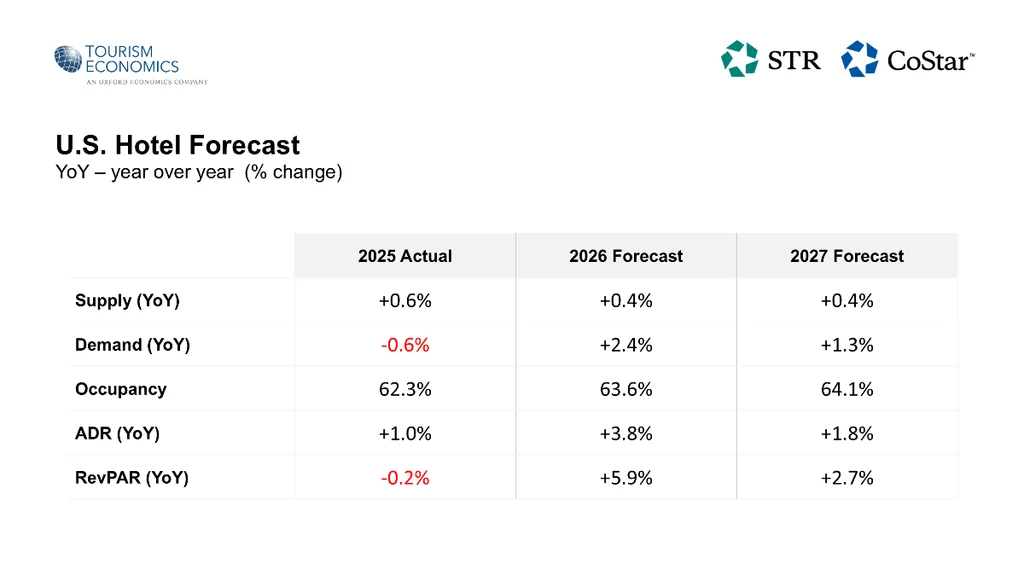
For the remainder of 2026, the updated projections reveal across-the-board upgrades for key performance indicators. Projected gains in average daily rate (ADR) and revenue per available room (RevPAR)—widely considered the industry’s most critical bellwethers—were increased by 0.7 percentage points and 1.5 percentage points, respectively. Furthermore, full-year occupancy is now expected to reach 63.6 percent, marking a 0.5 percentage point lift over previous estimates.
The positive momentum is not expected to evaporate when the calendar turns. Similar upward revisions have been encoded into the 2027 outlook, with analysts forecasting further gains in occupancy (up 0.7 percentage points), ADR (up 0.2 percentage points), and RevPAR (up 0.6 percentage points). These adjustments signal that industry leaders believe the current travel cycle possesses deeper roots than previously anticipated, carrying vital strength well into the medium term despite an intricate web of economic crosscurrents.
Statements From Leadership
The decision to revise forecasts upward at this late stage in the year stems from a remarkably vigorous autumn travel season that caught many observers by surprise. Amanda Hite, president of STR, pointed to sustained consumer enthusiasm as the primary catalyst behind the positive numbers.

"Travel momentum carried into the autumn months, prompting another round of upgrades to the forecast," said Hite, detailing the forces shaping the current landscape. "The industry continues to outperform, with total year-to-date demand coming in above the pre-pandemic high and an annual total on pace for an all-time record. Nearly half of that demand growth year to date has occurred in the past two months despite consumers facing persistent inflation."
This surge in demand has occurred against a backdrop of complex consumer behavior. While inflation has remained a constant pressure point for households across the United States, Americans have consistently prioritized travel and experiential spending over other discretionary categories. However, Hite noted that this extraordinary pace cannot continue indefinitely without hitting natural economic friction.
"Once we get further into next year, growth is expected to normalize as economic uncertainty and tougher comparisons create greater headwinds," Hite added, emphasizing that the exceptional growth rates seen in late 2026 will eventually moderate as the market matures and year-over-year comparables become much more challenging.
Looking toward the macroeconomic drivers of 2027, Aran Ryan, director of industry studies at Tourism Economics, highlighted a shifting landscape of financial support systems and potential vulnerabilities.
"We expect a supportive backdrop for U.S. travel in 2027," said Ryan. "AI-led business investment is lifting growth, and equity gains should keep supporting higher-income travelers, though elevated inflation is squeezing other households."

The divergence in consumer experiences remains a defining characteristic of the current economic cycle. While high-income earners buoyed by robust equity markets continue to drive luxury and upper-upscale segments, middle- and lower-income demographics face tighter budget constraints. Nevertheless, broader commercial sectors are stepping in to fill the gaps. According to Ryan, group travel demand and a gradual, ongoing recovery in international inbound visitation are providing critical layers of support to offset domestic consumer fatigue.
At the same time, the macroeconomic dashboard is not without warning lights. Ryan cautioned that the updated forecast remains vulnerable to exogenous shocks and structural shifts. "Still, the forecast faces risks, including an AI-led equity downturn and a potential government shutdown at the end of 2026," he noted, underscoring the delicate equilibrium required to maintain the current trajectory.
Beyond top-line metrics such as ADR, RevPAR, and occupancy, hotel operators are also navigating a shifting cost structure that directly impacts the bottom line. Operational efficiency and expense management have taken center stage as properties attempt to protect profit margins in an inflationary environment.
Commenting on the profitability outlook, Hite pointed out that gross operating profit (GOP) trajectories are closely mirroring revenue adjustments. "Similar to the top-line metrics, GOP gains are expected to moderate in 2027," said Hite.
Fortunately for hotel owners and asset managers, the pressure on operational expenditures is showing signs of easing. "Slower growth in A&G and utilities should bring total expense growth more in line with inflation, while slightly stronger revenue growth supports continued margin expansion," Hite explained, offering a reassuring outlook for property-level earnings as the industry transitions into the new year.
Related News