To Upgrade or Not to Upgrade? Why You Should (Almost) Never Upgrade Your Delta Credit Card
Article Editorial Team
When major financial institutions and airlines roll out lucrative welcome offers on popular travel credit cards, the exact same dilemma routinely floods expert inboxes: Should an existing cardholder upgrade their current account, or is it better to submit an entirely new application?
Upgrade promotions on co-branded travel credit cards are commonplace in the industry. Issuers like American Express and airlines like Delta frequently incentivize existing customers to step up from mid-tier options—such as the popular Delta SkyMiles Gold American Express Card—to higher-end products like the Delta SkyMiles Platinum American Express Card. These promotional pitches usually promise enhanced ongoing travel perks and expanded earning structures, but they inevitably come paired with a heftier annual fee.
Yet, for seasoned points and miles enthusiasts, the analytical answer to this common financial question is almost universally consistent: No, it rarely makes sense to take the upgrade. However, before navigating the complex landscape of airline credit cards, consumers must first understand the intricate web of application rules, welcome bonus restrictions, and credit score implications that govern modern travel rewards.
The Foundations of American Express Application Rules
To understand why upgrading is often a suboptimal strategy, it is helpful to examine how major credit card issuers regulate their application pipelines. Every bank maintains its own distinct set of guidelines regarding credit card approvals. For instance, Chase famously enforces its strict 5/24 rule, which automatically rejects any new card application if the applicant has opened five or more personal credit cards across any bank within the preceding 24 months.
American Express operates under a fundamentally different philosophy. Amex historically enforces a once-per-lifetime rule on welcome bonuses for each of its specific credit card products. This restriction dictates that if an individual has held a particular Amex card in the past, they are generally ineligible to earn a welcome bonus on that exact same card again. In practice, however, this lifetime restriction is not permanent. Industry data indicates that American Express typically resets bonus eligibility for a closed card approximately seven years after the account has been shut down, and occasionally even sooner under specific promotional conditions.
Therefore, while American Express may not scrutinize an applicant’s broader credit card history across competing financial institutions to the same extent as Chase, they closely evaluate an individual’s historical relationship with Amex products. Crucially, this evaluation applies regardless of whether the cardholder actually earned a welcome bonus during their previous tenure with that specific card.
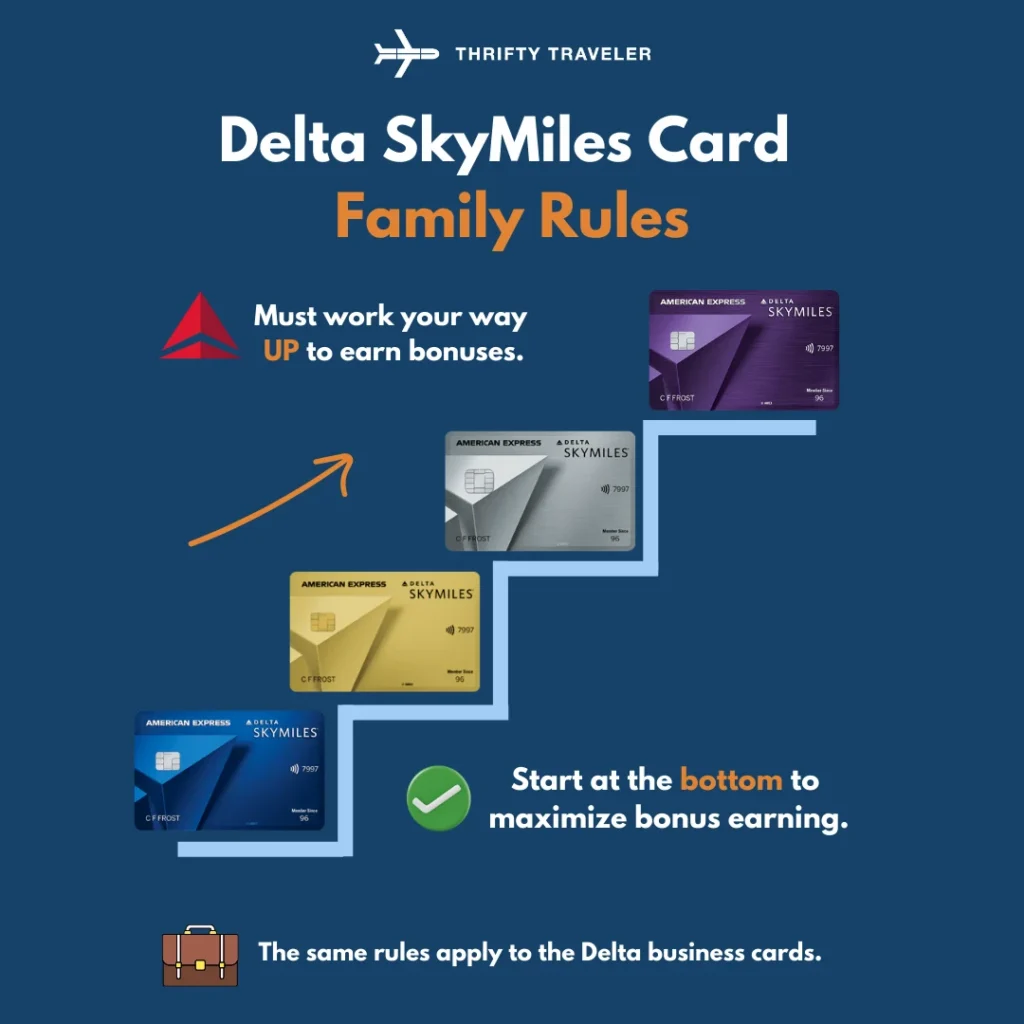
Complicating matters further, American Express implemented sweeping restrictions across its Delta SkyMiles credit card portfolio that significantly tightened how welcome bonuses are awarded based on historical product ownership. Under these regulations, consumers are generally allowed to work their way up the traditional hierarchy of Delta cards—progressing from entry-level to mid-tier and premium tiers—and theoretically earn a welcome bonus on each along the way.

However, the reverse path is heavily restricted. If an individual has previously held or received a welcome bonus on the Delta SkyMiles Platinum Card, they are barred from earning a welcome bonus on the Delta SkyMiles Gold Card. Conversely, holding a lower-tier card does not preclude an applicant from subsequently applying for and earning a bonus on a more expensive, higher-tier card, provided they navigate the sequence correctly. Because the Delta Gold, Delta Platinum, and Delta Reserve cards are treated as entirely distinct credit card products by the issuer, consumers maintain the legal eligibility to open each of them separately—as long as they apply outright rather than through an internal product change.
Weighing Upgrade Offers Against New Application Bonuses
Whenever Delta and American Express launch elevated welcome bonuses on their co-branded SkyMiles card lineup, their primary objective is acquiring fresh cardholders. Simultaneously, however, the financial institutions deploy targeted upgrade incentives to existing customers, encouraging them to migrate to superior tiers.
In the vast majority of situations, accepting these internal upgrade offers is a financial misstep. Choosing to upgrade an existing account effectively forfeits the opportunity to secure a substantially larger public welcome bonus on that same card down the road.
Consider a recent promotional offer distributed to existing cardholders attempting to entice a transition from the Delta SkyMiles Gold Card to the Delta SkyMiles Platinum Card. The targeted upgrade incentive offered 30,000 bonus SkyMiles and a $250 statement credit after meeting a $3,000 spending requirement within the first six months of account modification. By comparison, public welcome offers for new applicants on the Delta SkyMiles Platinum Card have frequently reached as high as 90,000 SkyMiles alongside a $300 statement credit after a $4,000 spend requirement over the same six-month window. While an upgrade bonus is better than nothing, it pales dramatically in comparison to the rewards available through a brand-new application.
It is worth noting that American Express utilizes a variable welcome offer structure for its SkyMiles card portfolio, meaning specific bonus amounts can fluctuate by applicant. To mitigate the guesswork, Amex utilizes an "Apply With Confidence" feature. This digital tool allows prospective applicants to submit an official credit card application and discover the exact welcome offer they qualify for before the hard credit inquiry is formally executed, giving them the option to withdraw the request if the assigned bonus is unsatisfactory.
Because of how Amex structures its portfolio rules, a current Delta Gold cardholder remains fully eligible to apply for a new Delta Platinum card outright, clearing the path to the maximum available welcome bonus, provided they have never earned a bonus on the Platinum or Reserve products before. Opting for an automated upgrade instead permanently forecloses the opportunity to collect those lucrative introductory windfalls.
The math becomes even less favorable when considering the ultra-premium Delta SkyMiles Reserve Card, which is heavily marketed for its airport lounge access and accelerated pathways toward Delta Medallion elite status. Upgrading an existing Gold card directly to the Reserve card eliminates eligibility for both the Reserve welcome offer and the intermediate Platinum welcome offer. By contrast, a traveler who strategically skips the middle tier and applies for the Reserve card outright captures a massive influx of introductory miles that would otherwise be permanently lost.

Navigating Card Downgrades and Credit Score Impacts
While upgrading an active account is rarely advantageous, the reverse process—downgrading a credit card—has evolved into a safe and effective financial management strategy. Thanks to updated welcome bonus eligibility restrictions implemented by American Express, cardholders facing steep annual fee increases or shifting travel habits have viable exit routes.
For example, consumers who currently hold the Delta Reserve card but are dissatisfied with evolving airport lounge access policies and visit restrictions can safely downgrade their account to the lower-cost Delta Platinum or Delta Gold cards. This product change successfully trims unnecessary annual fee expenditures without burning bridges regarding future bonus eligibility. Furthermore, downgrading leaves the door open for American Express to potentially target the customer with a future upgrade incentive once their spending habits or travel needs shift again.
When evaluating these account adjustments, consumers must also consider the distinct mechanics governing credit scores. Submitting an application for a brand-new credit card inevitably triggers a hard credit inquiry, which can cause a temporary, minor dip of five to ten points in an individual’s credit score. However, this transient fluctuation is generally offset over the long term by the expansion of total available credit and the maintenance of a healthy credit utilization ratio, assuming the account is managed responsibly.
Conversely, upgrading or downgrading an existing account functions as a product change rather than a new line of credit. In these instances, the issuing bank simply reclassifies the current account, allowing the cardholder to retain their existing account history, credit limit, and frequently even the exact same physical plastic card number. Because a new credit line is not technically being opened, the bank does not perform a hard credit inquiry.
The financial trade-off for avoiding a hard pull during an upgrade, however, is the complete forfeiture of the substantial point yields associated with new card acquisitions. For most travelers balancing the long-term value of tens of thousands of SkyMiles against a minor, temporary credit score fluctuation, submitting a fresh application remains the mathematically superior choice.
Ultimately, when cardholders confront the recurring crossroads of whether to upgrade an existing Delta credit card or submit an application for a new one, the financial reality remains clear. In the vast majority of scenarios, navigating the application rules carefully and applying for a new card outright yields a far superior return in welcome bonuses and travel perks than accepting a bank’s automated upgrade offer.
Related News