Mapping the Migration: Kansas City Volunteers Unlock the Secrets of the Prothonotary Warbler
Article Editorial Team
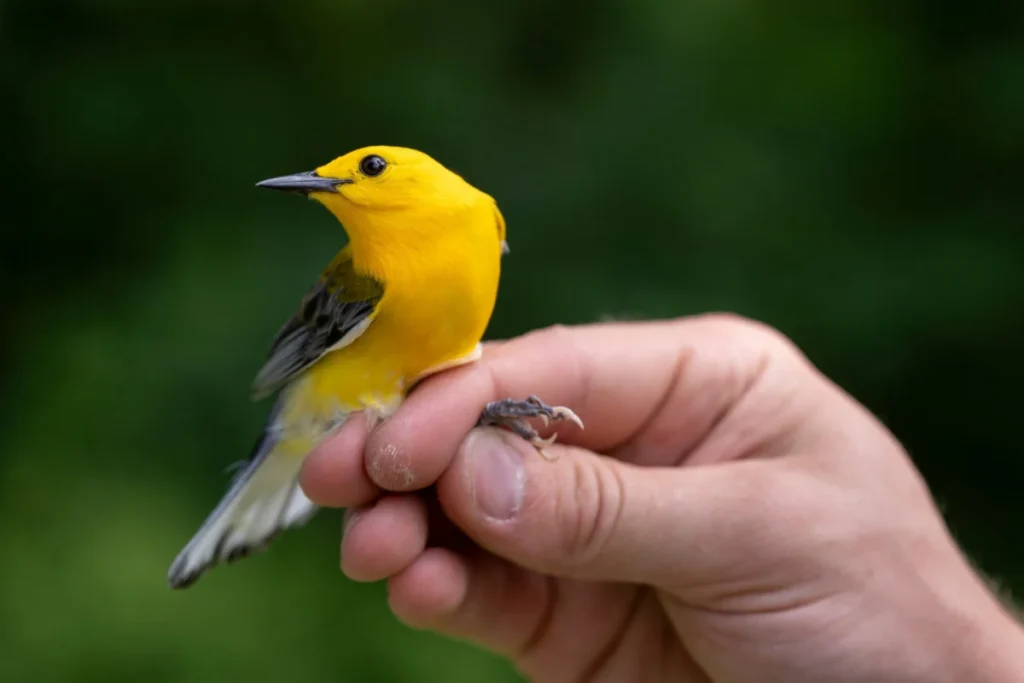
Ann Tanner is running on four hours of sleep, yet she shows no signs of fatigue. On a humid June morning, she greets her team with infectious enthusiasm and a surprisingly firm handshake in the parking lot of Wyandotte County Lake Park in Kansas City, Kansas. Down the hill, a male Prothonotary Warbler—a brilliant, golden-feathered songbird—is busy defending his nesting territory. His sweet, ringing song punctuates the morning chorus of the surrounding woods, unaware that he is the primary subject of an ambitious, high-stakes scientific mission.
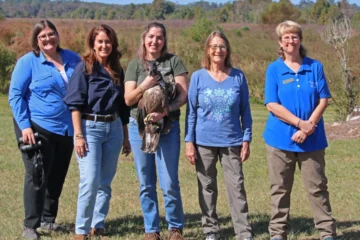
As the president of the Burroughs Audubon Society of Greater Kansas City and a dedicated Johnson County K-State Extension Master Naturalist, Tanner has spent the last year spearheading a critical five-year quest. Her goal is to solve a long-standing mystery: the precise migration route of the Prothonotary Warblers that breed in the Kansas City region. Last year, this team successfully captured the very bird singing below them, nicknamed him “Hydrogen,” and carefully fastened a tiny geolocator to his back. In the 12 months since, Hydrogen has embarked on a perilous journey to South America and back. Only the bird knows the exact path he took, but the group milling around the parking lot is determined to find out. They have gathered with a singular purpose: to recapture him and retrieve the precious data stored on his tiny tracking device.
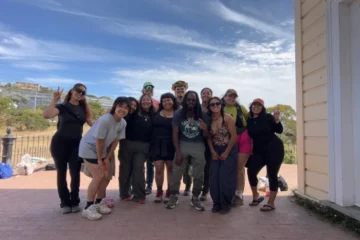
The group of 15 participants is a diverse cross-section of the local conservation community, including Burroughs Audubon Society members, Johnson County Master Naturalists, retirees, young professionals, and both seasoned ornithologists and novice birders. Each person has contributed to the months of preparation leading up to this morning. Once the necessary gear—mist nets, a handmade Prothonotary Warbler decoy, and a loudspeaker—is positioned, the group retreats about 30 feet. Gabe McClain, a master’s student at Pittsburg State University, begins broadcasting the territorial calls of a male Prothonotary Warbler.
The reaction is almost immediate. “I see him!” Tanner calls out after just a few minutes. A flash of bright yellow appears as the bird begins chirping aggressively at the decoy, viewing the recording as a rival intruder. He makes a bold swipe at the wooden decoy, flies into the net, and then, in a stroke of bad luck, bounces out.
McClain persists, adjusting the speaker to play a different call. A few minutes later, another yellow blur darts into the net. The group surges with excitement, waiting in breathless anticipation as McClain carefully extracts the bird. He looks up with a rueful smile and shakes his head: it is the male’s mate, not Hydrogen.
However, Hydrogen soon makes his return. After a tense, quiet interval, someone whispers, “Got the male!” McClain moves in to extract the bird, and a wave of relief washes over the group when he confirms, “Yep, he’s got his geolocator on.” McClain holds the brilliant bird, noting its piercing black eye and vibrant plumage, up to his impromptu fan club. Pointing to a small, rice-sized bulb on the bird’s rump, McClain explains that this tiny piece of technology is the culmination of their hard work. A volunteer quickly cuts the filament securing the device, and in seconds, the tracker is off, holding the hidden secrets of Hydrogen’s year-long journey.
For many birders in the United States, Prothonotary Warblers are synonymous with the dark, moss-draped swamps of the Deep South. Kansas City marks roughly the westernmost edge of their range, but recent observations suggest that boundary is shifting. For at least the last four decades, these warblers have been moving steadily northwest. The reasons for this migration shift remain a subject of intense debate among scientists. Factors such as hurricanes, extreme droughts, and the widespread destruction of wetlands in the South may be displacing the population, though other environmental pressures could be at play. The team in Kansas City is now a vital node in an international effort to uncover the truth.
Erik Johnson, an assistant professor of wildlife management at Louisiana State University and former director of conservation science for Audubon Delta, coordinates the Prothonotary Warbler Working Group. This consortium of federal agencies, NGOs, and universities collaborates on large-scale research into the species’ survival. They investigate why populations are declining in some regions while rising in others, how climate change impacts reproductive success, and whether migratory paths overlap with offshore wind energy projects.
Despite these efforts, there remain more questions than answers, particularly regarding the western population. While this specific group is increasing, the species as a whole is in decline. Scientists like Johnson are eager to understand the drivers of these divergent trends. Mapping the migration of the Kansas City population could reveal whether these birds are utilizing different nonbreeding habitats, taking safer routes, or migrating during more favorable weather conditions.
The partnership with the Kansas City group began in 2023 when Johnson received a notably enthusiastic email from Tanner. She wanted to know how her local organizations could contribute to the migration study. While Tanner was not a professional ornithologist, Johnson saw a unique opportunity. He lacked migration data for the warblers breeding in Kansas, and Tanner’s passion was backed by a organized, motivated team. “Oh, this is interesting. Yeah, let’s see where this goes,” he recalls thinking at the time.
Jack Corrigan, the first Missouri Master Naturalist to join the effort, now leads the Missouri arm of the project. To understand how the local birds fare, he takes his team on regular nest box monitoring routes, such as those at the Platte Falls Conservation Area. Navigating through flooded, swamp-like forests, the team checks boxes designed to provide safe haven for the warblers. The environment is rugged, often thick with mosquitoes, but the volunteers are unfazed.
When Corrigan knocks on a nest box, a yellow blur often streaks out, and the female begins calling an alarm. He checks the box to reveal delicate, grape-sized eggs tucked into a nest of twigs and moss. He photographs the interior, logs the data, and moves on. While protocol suggests weekly checks, Corrigan often visits every three days, driven by a personal commitment to the birds’ welfare. He worries about predation or illness, and his vigilance is justified. While natural cavities suffer from high rates of predation and Brown-headed Cowbird parasitism—leading to only about 40 percent success—the Kansas City nest box program boasts an impressive 80 percent fledging rate, thanks to predator guards and constant monitoring.
Building these boxes is not merely a hobbyist’s project; it is a serious conservation tactic. “Predator-guarded boxes are very well documented to almost double the reproductive success,” Johnson notes. By providing secure nesting sites, the volunteers are literally increasing the number of birds entering the population each year. For Corrigan, the work is about the bigger picture: “You’re acting locally, but you’re affecting globally.” The data gathered is uploaded to NestWatch, a program managed by the Cornell Lab of Ornithology, which provides scientists with the raw numbers needed to track reproductive success across the continent.
But even with successful fledging, the mystery of the southward migration remained. To solve it, the Burroughs Audubon Society invested in geolocators, recruiting experts like Andrew George and Alice Boyle to assist with deployment. The local army of volunteers is the backbone of this effort; because geolocators are expensive and the recapture of the birds is far from guaranteed, scientists rely on the volunteers’ ability to locate and protect nests. This close monitoring ensures the birds have the best possible chance of survival.
After an initial setback in 2024 where none of the tagged birds were recaptured, the team persisted. In 2025, they deployed more trackers, including the one placed on Hydrogen. On May 27, 2026, a volunteer spotted him back at the lake. When George downloaded the data—over 100,000 readings of solar radiation and barometric pressure—and wrote the code to interpret them, he finally produced the first migration map for a Kansas Prothonotary Warbler.
The map was a revelation. On October 24, 2025, Hydrogen arrived in the Department of Bolivar in northern Colombia, having traveled 2,800 miles in 47 days. He spent 168 days in the Ciénaga Grande de Magangué, a region of flooded forests that is unfortunately being cleared for agriculture. On April 9, 2026, he began his return journey, flying 3,000 miles in just 24 days. In a single year, Hydrogen used habitats in five U.S. states, two Mexican states, two Honduran departments, two Nicaraguan departments, one Panamanian province, and one Colombian department. It is a striking reminder that the survival of this species depends on international cooperation.
To foster this global connection, Audubon has begun a pilot program pairing the Burroughs Audubon Society with the Ciénaga de Mallorquín Ecopark in Barranquilla, Colombia. This partnership promotes ecotourism that integrates conservation with economic development, restoring mangroves and involving the local community. It serves as a model for how bird conservation can improve quality of life and strengthen local identities.
As the summer of 2026 continues, the work in Kansas City is only intensifying. After the excitement of retrieving Hydrogen’s data, the team spent the rest of the day attempting to recapture another bird, “The Dude,” to gather more data. Though the effort was grueling and the initial attempt to retrieve his geolocator failed, the team’s resolve remained unbroken.
“Trying to catch this bird is not for the faint of heart, because you know you’re going to fail more than you’re going to succeed,” Tanner says. Yet, for her and her team, the success of tracking Hydrogen feels like a miracle. By the end of the summer, George and McClain had deployed 36 geolocators across eastern Kansas. As the team continues their watch, they remain fueled by a sense of hope—the kind of hope that turns a group of dedicated volunteers into a vital force for global conservation.
Related News