Beyond the Big Names: Six Overlooked Mountain Towns for Your Winter Getaway
Article Editorial Team
When winter daydreams take hold, certain legendary names inevitably float to the surface. Destinations like Jackson, Wyoming; Stowe, Vermont; and Telluride, Colorado dominate the collective imagination of skiers and snowboarders, prompting annual fantasies of taking a seasonal sabbatical, purchasing a camper van, and living out the ultimate alpine dream for three months in the heart of winter. However, for travelers seeking to escape the crushing crowds, exorbitant lift ticket prices, and notorious traffic bottlenecks of these headline-grabbing resorts, an entire network of alternative winter adventure spots deserves the spotlight.
As a reporter covering mountain towns for Outside, plotting out personal winter getaways is an annual ritual that begins well before the first flakes fall. While visiting established destinations like Park City remains an enjoyable option, the locations that generate the most genuine excitement are those that fly under the radar. These off-the-beaten-path destinations may not command heavy media hype, but they offer exceptional access to deep powder stashes, sprawling trail systems, and resort lift lines that move exponentially faster than their better-known counterparts.
While some of these locations serve as longtime personal favorites, others remain on the horizon as must-visit destinations. These six often overlooked winter mountain towns offer compelling alternatives for travelers once the snow begins to gather.
Boone, North Carolina
A legitimate winter destination in the American South might sound counterintuitive, but Boone stands as a vibrant college town that expands significantly when Appalachian State University’s roughly 20,000 students are in session. The town possesses all the classic hallmarks of a spirited mountain community, complete with local dive bars and casual eateries designed to keep visitors satiated after a day outdoors. Nestled in North Carolina’s High Country, Boone is surrounded by 5,000- and 6,000-foot peaks that capture some of the heaviest snowfall totals in the region. Three distinct ski resorts operate within a 30-minute radius of downtown, complemented by some of the most consistent cross-country skiing in the South across a series of high-elevation peaks near the Tennessee border.

Among the downhill options, Beech Mountain Resort holds the distinction of being the highest ski resort in eastern North America, featuring a summit elevation of 5,506 feet. The facility includes the 5506’ Skybar situated at the very top of the mountain alongside its own operating brewery in the base village. Spanning 95 acres with just over 800 feet of vertical drop, the terrain requires multiple laps to accumulate significant vertical footage, but the terrain park continues to improve annually. Skiers and riders can typically count on roughly 80 inches of natural snowfall each winter, with full-day adult lift tickets starting at $57 on weekdays.
For those seeking alternative winter adventures, cross-country skiing across Roan Mountain offers an exceptional experience. This high ridge tops out at 6,285 feet, attracts heavy snowfall, and presents a diverse landscape ranging from high-elevation grassy balds to narrow singletrack paths winding through dense rhododendron tunnels. Because rental equipment remains scarce in the region, visitors must bring their own touring skis. Beginning at Carver’s Gap, a gated Forest Service road climbs gradually for approximately two miles toward the Rhododendron Gardens, delivering expansive long-range views in multiple directions alongside opportunities to explore more challenging trails branching off the main route.
Duluth, Minnesota
Positioned at the western tip of Lake Superior, Duluth has evolved from a historic shipping and industrial center into a thriving outdoor adventure hub. A world-class mountain bike trail system weaves through the hills lining the edge of downtown, but the city’s location in northern Minnesota ensures that winter arrives with considerable force. Duluth typically accumulates about 86 inches of lake-effect snow each winter, and persistent sub-freezing high temperatures on more than 100 days a year ensure the snowpack remains stable. These consistent cold temperatures create ideal conditions for ice climbing, while the reliable snow cover and extensive trail network transform the city into a premier destination for fat-biking and cross-country skiing. Downhill skiing is also readily available at nearby Spirit Mountain, which spans 175 acres of terrain featuring a 700-foot vertical drop.
Spirit Mountain showcases a robust regional ski culture, featuring some of the finest blue cruisers in the Midwest, many of which offer sweeping vistas of downtown Duluth and Lake Superior. The facility maintains two distinct terrain parks—one tailored for beginners looking to build foundational skills and another designed for advanced riders seeking progression. An accommodating uphill policy also welcomes backcountry touring enthusiasts seeking to earn their turns using human power, with adult lift tickets starting at $83.

As a recognized cycling community, Duluth pivots naturally to fat-biking when winter weather takes over. Numerous segments of the Duluth Traverse, an ambitious 40-mile route spanning the entire width of the city, are professionally groomed for fat tires throughout the winter months. The machine-built trails within the Mission Creek area, characterized by rolling terrain and banked turns, offer particularly engaging riding conditions when covered with packed snow. Local outfitter Day Tripper provides guided fat-bike tours and equipment rentals for visitors looking to explore the trail network.
Jackson, New Hampshire
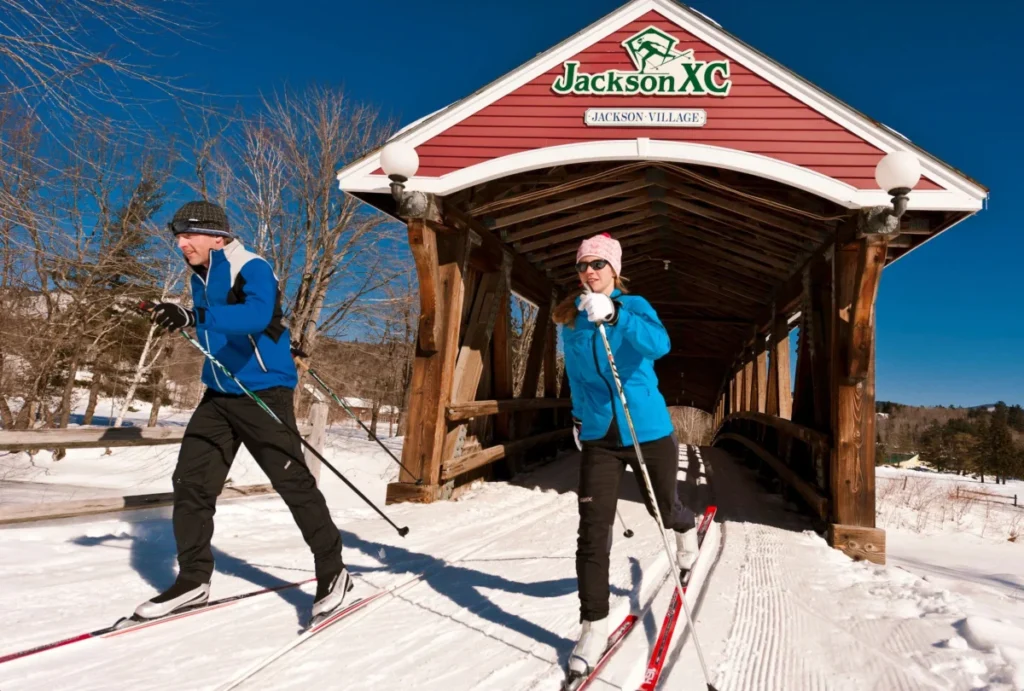
Following a winter that brought exceptionally heavy snowfall to New England—with high-elevation mountain zones receiving upwards of 200 inches—the tiny village of Jackson was well-positioned to capitalize on the deep conditions. This picturesque community features a classic general store and a historic covered bridge, situated directly on the border of the White Mountain National Forest. The location provides rapid access to downhill skiing at Black Mountain alongside roughly 90 miles of cross-country ski trails winding through the valley.
While Jackson lacks the widespread commercial cachet of certain other New England ski destinations, American ski culture received an early foundation here when Black Mountain opened its doors in 1935, establishing it as one of the earliest lift-serviced operations in the United States. That heritage remains visible today through traditions like Friday Night Lights, a weekly community gathering where participants don headlamps and ski en masse to the summit of the mountain.
The Jackson Ski Touring Foundation grooms and maintains approximately 150 kilometers of interconnected trails centered around a main touring facility offering rentals and instructional programs. The network traverses the community across three consecutive river valleys spanning 60 square miles, treating visitors to views of Mount Washington from open meadows, tight forest singletrack, and even trailside dining options in select areas, with day passes starting at $29.

No visit to Jackson is complete without experiencing Black Mountain itself, an independently operated resort featuring 140 acres of glades, narrow traditional groomers, and minimal lift lines. The mountain provides 1,100 feet of vertical drop, featuring its steepest terrain near the summit, while the Shovel Handle Pub at the base area serves as a central hub for après-ski activities. Adult lift tickets begin at $49.
Pagosa Springs, Colorado
Note: While Pagosa Springs and the surrounding region experienced flooding, the town and the Wolf Creek ski area remain fully open, actively encouraging travelers to visit this winter as tourism forms a vital pillar of the local economy. Visitors should note that local residents and businesses may still be managing the lingering impacts of the flood, making patience and understanding valuable assets alongside financial support.
The San Juan Mountains host some of Colorado’s most iconic mountain towns and highly regarded ski slopes, though most visitors rarely venture beyond major hubs like Telluride and Silverton. Exploring deeper into the mountains of southwest Colorado reveals Pagosa Springs, situated along the banks of the San Juan River. While internationally recognized for its natural geothermal hot springs, the surrounding mountain terrain offers equally compelling winter recreation. Located 23 miles from town, Wolf Creek Ski Area is widely recognized as one of the snowiest destinations in Colorado, capturing an average annual snowfall of 430 inches.
For visitors seeking diversity beyond downhill skiing, seasonal waterfalls transform into vertical ice-climbing routes as temperatures drop, while the local Nordic club maintains more than 50 kilometers of groomed skate and classic ski trails near the community.

Wolf Creek operates as a traditional, no-frills ski area focused primarily on snow quality and terrain variety. The 430 inches of annual snowfall blanket wide cruisers and extensive glades, with a significant concentration of expert terrain located among steep upper bowls and widespread tree skiing. Adult lift tickets are competitively priced, starting at approximately $110.
Additionally, the local cross-country trail network originates directly within town, featuring a beginner-friendly one-mile loop inside the municipal park. The area also provides opportunities for fat-biking via an 8.5-mile loop groomed specifically for winter cycling through a ponderosa pine forest, with equipment rentals available through Pagosa Mountain Sport.
Ogden, Utah
While destinations like Park City and Salt Lake City command the majority of national ski media attention, Ogden offers a compelling, lower-profile alternative. Situated between the Great Salt Lake and the Wasatch Mountains approximately 40 minutes north of Salt Lake City, this historic city serves as Utah’s first permanent European settlement. Downtown Ogden centers around 25th Street, a historic corridor characterized by nineteenth-century architecture and an upscale western atmosphere. Three distinct ski resorts renowned for deep powder are located within 30 minutes of downtown. Powder Mountain anchors the trio with more than 8,000 acres of terrain, accompanied by Snowbasin—consistently ranked among the nation’s top resorts by Ski magazine—and the smaller Nordic Valley, which offers a neighborhood hill atmosphere complete with night skiing. Crucially, visitors here can bypass the notorious canyon traffic frequently encountered near Salt Lake City.
Powder Mountain represents the largest ski resort in the Lower 48 states, providing 2,800 acres of lift-served terrain and over 2,000 feet of vertical drop. However, the resort’s extensive sidecountry remains its defining feature. Accessing the Powder Country or Woody’s World entrance gates from the lift-served boundaries grants skiers entry to 1,200 acres of ungroomed, off-piste terrain. A dedicated shuttle bus system retrieves skiers from the base of these runs and transports them back to the front side of the mountain, eliminating the need for exhaustive boot-packing. Adult lift tickets start at $99.

Visitors can also explore regional snowmobiling opportunities, particularly within the Monte Cristo area east of the Ogden Valley. This zone offers extensive snowmobile terrain, including a 63-mile groomed loop tailored for beginners that provides expansive views of the surrounding valley. Local outfitters such as Club Rec North provide guided tours and equipment rentals directly adjacent to the trailhead, with tour packages starting at $229.
Winthrop, Washington
Located in the North Cascades, this former gold-mining settlement embraces its historical heritage through a commercial district lined with Old West-style false fronts and wooden boardwalks. Local outfitters continue to offer horseback excursions, including the annual Ride to Rendezvous, a multi-day horse-packing journey featuring a horse-drawn wagon train that participates in Winthrop’s local celebrations. Beyond its western roots, Winthrop has reinvented itself as a premier destination for cross-country skiing, anchored by the Methow Valley, which boasts one of the most extensive trail networks in the United States, comprising over 120 miles of groomed, marked, and maintained pathways.
Families visiting the area can also utilize the Winthrop Rink, an open-air ice-skating facility that serves as a community gathering space throughout the winter season.
The Methow Trails organization manages the extensive valley network, accommodating everyone from lodge-to-lodge tourers to individuals seeking strenuous vertical climbs. The organization hosts instructional clinics and training camps throughout the winter for those looking to refine their technique or experiment with biathlon events, with day passes beginning at $32.

For downhill enthusiasts, the nonprofit-operated Loup Loup Ski Bowl provides 300 acres of lift-served terrain featuring 10 distinct runs and 1,240 vertical feet of drop. The facility balances beginner trails with advanced terrain descending from the summit, alongside a welcoming uphill touring culture and a traditional luge course where visitors can pilot classic sleds down groomed mountain tracks. Adult lift tickets start at $80.
Related News