Guardians of Sacred Ground: How Fort Myers’ Historic Woodlawn Cemetery Became an Unlikely Wildlife Haven
Article Editorial Team
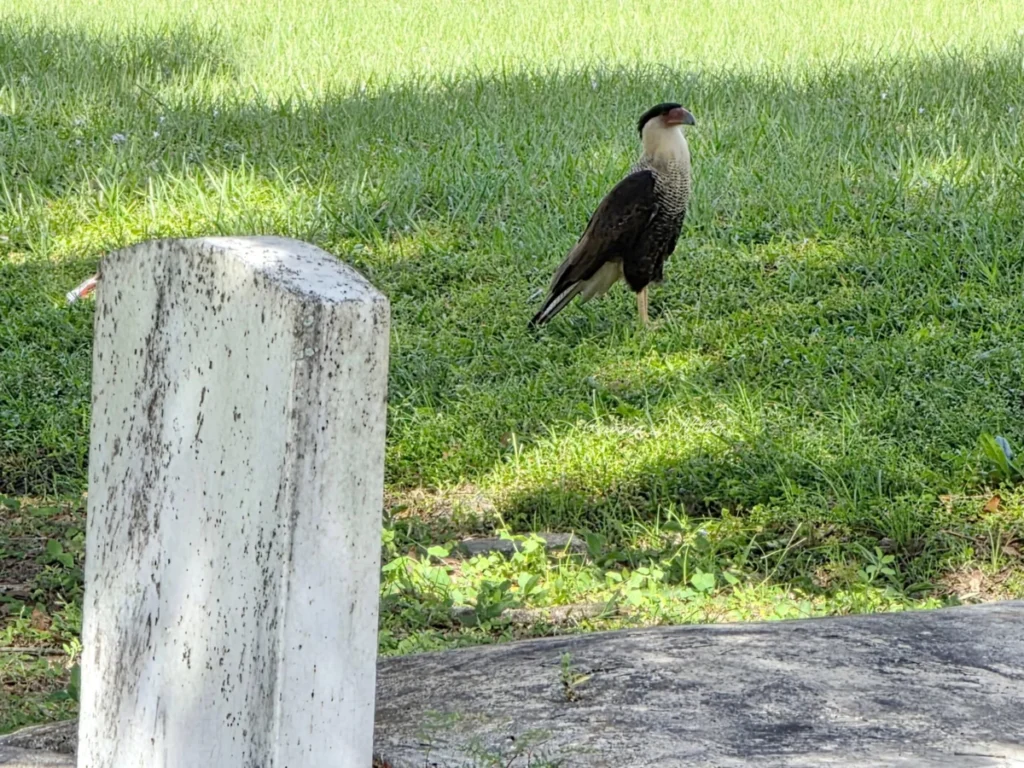
"Protecting historic green space protects more than history. It protects habitat. Shade for the owl. A perch for the hawk. Open ground for the caracara. Sky for a young eagle to grow into its crown."
These words, spoken by family historian and cemetery preservation advocate Ramona D. Miller, reflect a growing realization that the preservation of human heritage and the preservation of ecological health are inextricably linked. On October 9, Miller, who has dedicated much of her life to honoring the stories of those buried in historic Black cemeteries, witnessed a striking intersection of these two worlds at the historic Woodlawn Cemetery in Fort Myers, Florida. While walking the grounds—a site of profound cultural and historical significance—she encountered three Crested Caracaras, raptors known for their striking appearance and preference for open, semi-natural landscapes.
For Miller, the encounter was more than just a moment of avian interest; it was a realization that the ground she works so hard to protect serves as a sanctuary for more than just the ancestors. The Crested Caracara, often referred to as a "Mexican eagle" due to its prominence in Mexican culture, is a bird of the falcon family, though its behavior is more terrestrial than its cousins. With a distinct black cap that resembles a crown and long, yellow-orange legs designed for walking, these birds typically inhabit prairies, rangelands, and open pastoral habitats. While common in parts of Arizona, Texas, and central Florida, spotting them in a cemetery near the urban sprawl of downtown Fort Myers is an event that captures the imagination.
Miller’s connection to the land is deep-rooted. Raised in the nearby inland farming community of Immokalee, in Collier County, she grew up in a region where these birds are relatively common. Yet, despite her background, the October sighting was the first time she had truly "seen" them. Upon spotting the trio, she turned to technology to confirm their identity. Once she learned their name, the significance crystallized in her mind: they were survivors, finding a place to exist on sacred ground.
Woodlawn Cemetery is a site of immense historical weight. According to the Black Cemetery Network, the burial ground holds the remains of numerous African American families from across Southwest Florida. Its origins are rooted in the systemic injustices of the early 20th century; many of those buried there were residents of Immokalee who were denied burial access in their home county due to segregation. The Woodlawn section, which falls under the purview of the City of Fort Myers, was established around 1915 specifically to serve as a segregated burial space for the Black community.
For Miller, as a descendant and an advocate for the dignity of these burial grounds, the cemetery is a living archive. She recognizes that the responsibility of preservation extends to every aspect of the site—both the history embedded in the headstones and the ecology that persists among the trees and grass. After documenting the caracaras and learning that the species faces population threats in Florida, Miller reached out to Audubon Florida to share her findings, highlighting the role that protected, quiet spaces play in modern conservation.
The caracara sighting was not an isolated incident of wildlife discovery for Miller. Just days prior, she had observed a subadult Bald Eagle in the same vicinity. As a beekeeper, Miller is no stranger to the natural world; she regularly photographs Northern Cardinals, various hawks, and Blue Jays. However, the presence of the caracaras stood out as a poignant symbol of resilience. As Florida continues to develop at a rapid pace, the open spaces these birds require are vanishing. Finding them in a cemetery suggests that even our oldest, most protected human spaces are providing vital refuges for displaced wildlife.
The status of the Crested Caracara in Florida is a subject of ongoing interest for conservationists. While the species has faced population declines in some portions of its broader U.S. range—largely due to habitat loss and historical persecution—the situation in Southwest Florida remains more nuanced. Keith Laakkonen, an avid birder and the director at Audubon’s Corkscrew Swamp Sanctuary in Naples, notes that the local populations have been holding relatively steady.
"Their populations around here have been doing fairly well, and I have been seeing them in more and more places in Collier County that I never did before," Laakkonen explains. Historical data from eBird, a global database of bird sightings, confirms that while sightings are not necessarily common, a handful of Crested Caracaras have been reported in the general vicinity of the Woodlawn Cemetery neighborhood over the course of several decades. This suggests that while the cemetery is a unique urban oasis, these birds have been navigating the shifting landscapes of Southwest Florida for a long time.
For Miller, this revelation has fundamentally changed her relationship with the cemetery. She now views the site not only as a place of memory, lineage, and community history but as a vital habitat that demands stewardship. Her advocacy has taken on a new dimension; she has begun recording her observations from the cemetery on eBird. By contributing to this platform, Miller is helping to curate a dataset that is essential for conservationists, educators, and researchers who study the intersection of urban development and biodiversity.
"I guess I am being initiated into birdwatching," Miller says, reflecting on how her mission to honor the dead has led her to become a guardian of the living.
The work being done by individuals like Miller is central to the mission of organizations like Audubon, which views birds as a "superpower." The ability of these creatures—with their vibrant plumage, complex songs, and distinct behaviors—to capture human imagination is a powerful tool for environmental education. By fostering an appreciation for the birds that inhabit our local neighborhoods, parks, and even cemeteries, conservationists hope to inspire new generations to act as stewards of both the natural world and the historic sites that anchor our communities.
The experience at Woodlawn Cemetery serves as a quiet reminder to all who pass through our cities and towns. We often move through the world with a focus on our immediate destinations, rarely pausing to look at the trees or the sky in a forgotten field or a quiet, historical plot. Yet, these spaces are often more vibrant than they appear. The next time you walk through a historic cemetery or an old church lot, consider slowing your pace. Take a moment to study the canopy, observe the ground, and pay attention to the movement of the birds. You might find that the land is telling more than one story, and that in the quiet spaces left behind, life is finding a way to carry on. Through the lens of history and the eyes of a birdwatcher, even the most familiar ground can reveal something special, reminding us that we are all part of a shared, ongoing cycle of life and memory.
Related News